

Allahabad High Court Issues Comprehensive Guidelines On Mandatory Trial In Absentia Of Proclaimed Offenders U/S 356 BNSS
The Bench held that after statutory conditions are met, trial may proceed through amicus curiae despite the accused’s absence.

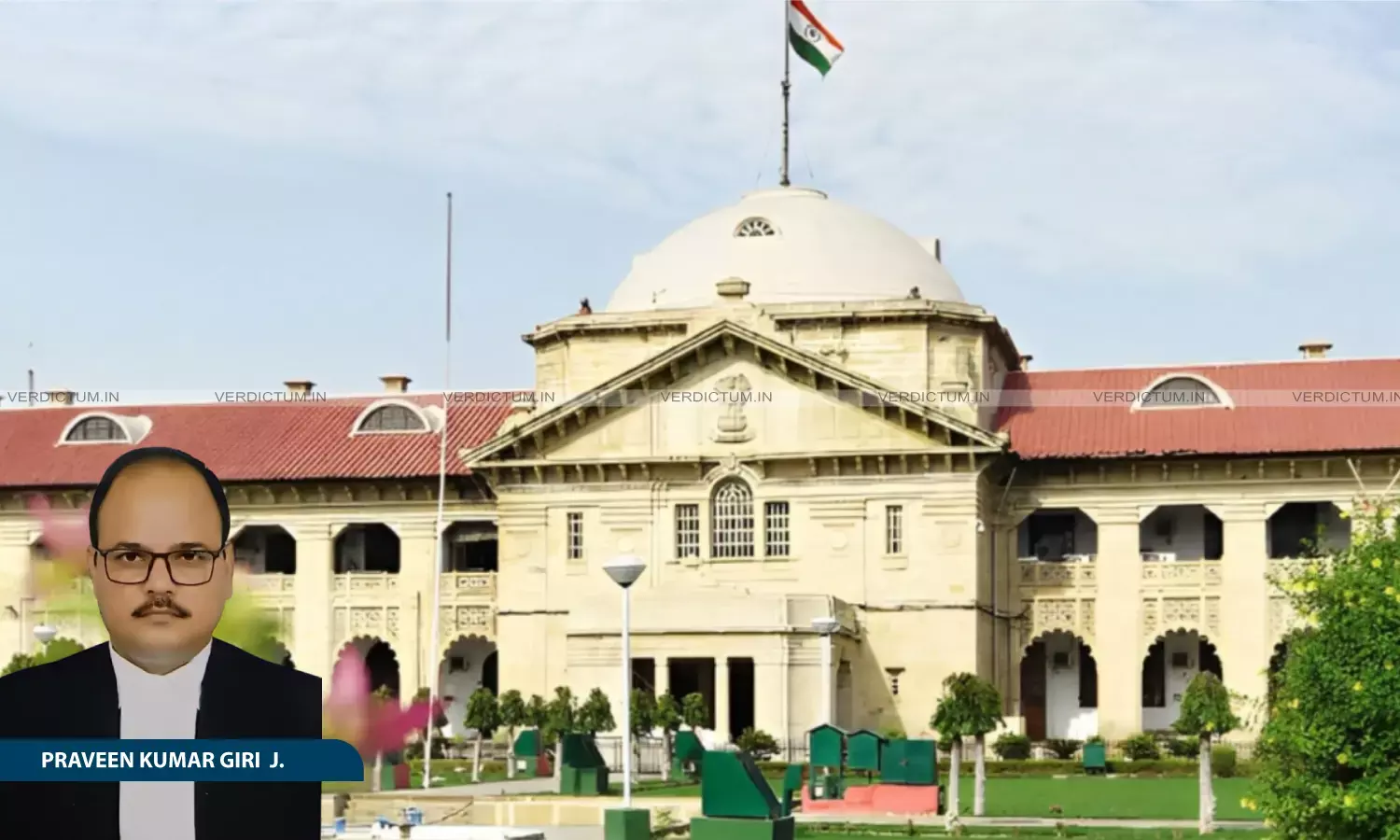
Justice Praveen Kumar Giri, Allahabad High Court
The Allahabad High Court has issued a set of comprehensive guidelines to streamline the implementation of Section 356 of the Bharatiya Nagarik Suraksha Sanhita (BNSS), which mandates the conduct of trials in absentia for proclaimed offenders. On the interaction between Section 82 and Section 356, the Bench noted that once the statutory conditions are met, including the 90-day waiting period post-charge framing, the trial must continue with the assistance of an amicus curiae to ensure the trial's integrity despite the accused's absence.
The Bench observed that these directives serve as a procedural roadmap for the judiciary and law enforcement to ensure that criminal proceedings are not indefinitely stalled by absconding accused persons. The guidelines clarify the mandatory duties of trial courts, including the appointment of defense counsel at state expense and adherence to specific timelines.
Justice Praveen Kumar Giri noted that criminal proceedings may face absconding accused at four stages, but trials can still conclude by following prescribed legal procedures. It observed, “First- An accused absconds during investigation and police report/charge sheet is submitted against him, declaring him a proclaimed offender. Second- An accused is not arrested during the investigation; either his arrest is stayed by any court of law, or his arrest is not required and he subsequently absconds after summoning and till the conclusion of the trial. Third- An accused is on bail during investigation, furnishing bail bond and surety and he absconds subsequently after summoning and till the conclusion of the trial. Fourth- An accused absconds after the framing of charge while he was released on bail/anticipatory bail, on furnishing his bail bond and surety.”.
Advocate Sanjay Singh appeared for the applicant and Pankaj Kumar, A.G.A. appeared for the opposite party.
The applicant, in the matter was facing trial for offences under Sections 307 and 504 of the IPC, although he was granted bail in 2021 and charges were framed in his presence in early 2024, he subsequently stopped appearing before the Trial Court.
Despite being aware of the proceedings, the applicant remained absent for over 29 scheduled dates, prompting the issuance of Non-Bailable Warrants and subsequent proceedings for proclamation and attachment.
The Additional Session Judge, Agra, issued a Non-Bailable Warrant against the applicant on October 18, 2024. Following continued non-appearance, the court declared the applicant a proclaimed offender under Section 82 Cr.P.C./BNSS and ordered property attachment under Section 83.
The applicant challenged the initial warrant before the High Court under Section 528 of the BNSS (corresponding to Section 482 CrPC), seeking to have the coercive measures quashed.
The Court noted that the BNSS has introduced transformative changes to criminal jurisprudence by prioritizing the rights of victims and the state to a speedy trial over an absconding accused’s tactical delays.
It specifically highlighted Section 356 of the BNSS, which permits the recording of evidence and the conclusion of a trial in absentia. The Bench noted that the applicant had "played hide and seek" with the court. It held that the safeguards under Section 356, such as the appointment of a legal aid counsel and the 30-day notice period before the commencement of the trial in absentia, sufficiently protect the accused's right to a fair trial while preventing the mockery of the judicial system.
“It is directed that when a public servant fails to discharge his duty, as prescribed by the law or a court order within the stipulated time or in accordance with the provision of the BNSS, such inaction on the part of the concerned official may attract the provisions of Disciplinary Rules, and contempt of court proceedings on the judicial side”, the Bench noted.
“It is directed that in cases of non-compliance with summons, warrants, or the provisions of Sections 84 and 85 of the BNSS (corresponding Sections 82 and 83 Cr.P.C.) or Section 174-A IPC (corresponding Section 209 BNS), within time frame and in the manner as specified under the law, the Presiding Officer shall immediately inform the concerned Superintendent of Police (S.P.), Senior Superintendent of Police (S.S.P.), or Commissioner of Police, as the case may be and the District Magistrate, so that appropriate departmental and/or criminal proceedings may be initiated against the erring officers or personnel, who cause a hindrance in imparting a speedy trial/justice to the aggrieved party in accordance with the Conduct and Disciplinary Rules, as applicable under the law.”, the Bench further noted.
The Court declined to quash the non-bailable warrant but directed that it be kept in abeyance for two months to provide the applicant a final opportunity to surrender and cooperate.
Cause Title: Ravi Alias Ravindra Singh v. State of U.P. and Another (Neutral Citation: 2026:AHC:101857)
Appearances:
Applicant: Sanjay Singh, Advocate.
Opposite Party: Pankaj Kumar, A.G.A.