

Conviction U/S 149 IPC Not Sustainable When Number Of Participants Fall Below Five Due To Acquittal Of Some Accused: Allahabad High Court
The Court noted that if convicted persons fall below five, Section 149 IPC cannot survive absent proof of an unlawful assembly sharing a common object.

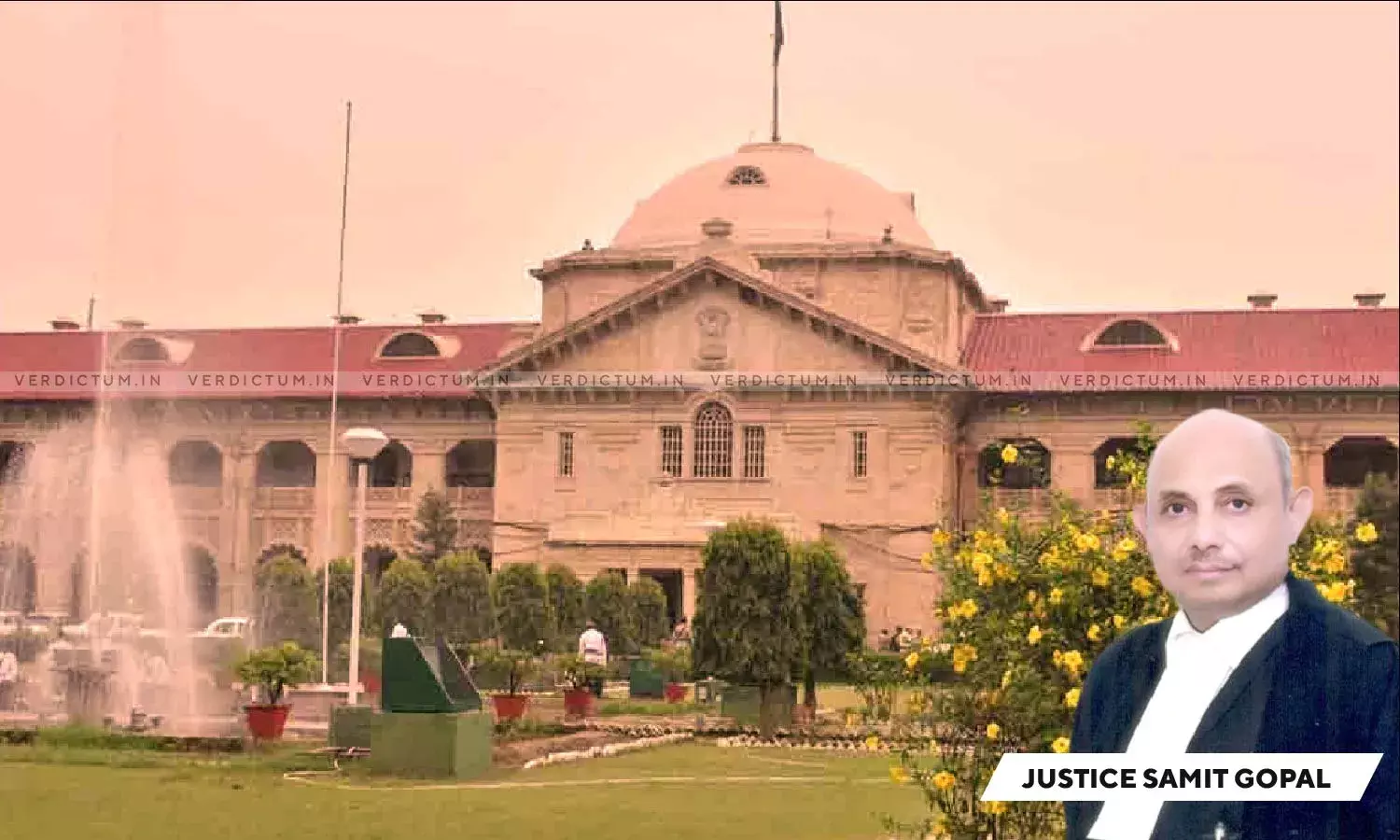
The Allahabad High Court has held that a conviction for an offence under Section 149 IPC cannot be sustained if the final number of persons found to be members of the assembly falls below five, and when the prosecution did not allege involvement of any other unidentified individuals.
The Court noted that while seven persons were initially accused in the matter, the trial court had acquitted four of them and the first appellant, Ram Palat, died during the pendency of the appeal, leaving, Bigranchhu as the only surviving appellant.
Justice Samit Gopal observed, “The acquittal of four accused rendered Section 149 I.P.C. inapplicable in this case as only two accused were convicted. In the present matter since no such situation arose warranting charging of the accused under Section 149 I.P.C. and none of the characters are involved this Court holds that the accused-appellants cannot be convicted with the aid of Section 149 I.P.C. as only two (2) accused were convicted by the trial court. This Court thus finds that the impugned judgement and order is totally illegal and such the same is hereby set aside”.
Advocate Pardeep Narayan Pandey appeared for the appellant and Ajay Singh, A.G.A.-I appeared for the respondent.
As per the facts, in a 1986 land dispute in Basti, where the informant and his son were allegedly assaulted with lathis and dandas by seven named individuals. It was alleged that the accused, led by Ram Palat, sought to prevent the victims from possessing land adjacent to Palat’s property.
The victims sustained multiple injuries, including a lacerated wound and a chip fracture, thereafter, following an investigation, a charge sheet was submitted against seven persons for offenses including rioting, attempted murder, and theft.
During the trial, one accused, Raja Ram, passed away, and the the Trial Court subsequently acquitted four other accused of all charges. While the remaining two, were also acquitted of the more serious charges under Sections 147, 307/149, and 379 IPC, they were convicted under Sections 323/149 IPC and sentenced to six months of rigorous imprisonment. During the pendency of the appeal, Ram Palat died, leaving Bigranchhu as the sole surviving appellant.
The Court’s referencing landmark Supreme Court precedents such as Mohan Singh v. State of Punjab 1962 SCC OnLine SC 82 and Subran v. State of Kerala (1993) 3 SCC 32, noted that the prosecution never alleged the presence of any unnamed or unidentified persons. Since the Trial Court had already acquitted four of the six persons who faced trial, the assembly was legally reduced to only two individuals.
“The failure to refer in the charge to other members of the unlawful assembly un-named and un-identified may conceivably raise the point as to whether prejudice would be caused to the persons before the court by reason of the fact that the charge did not indicate that un-named persons also were members of the unlawful assembly. But apart from the question of such prejudice which may have to be carefully considered, there is no legal bar preventing the Court of facts from holding that though the charge specified only five or more persons, the unlawful assembly in fact consisted of other persons who were not named and identified”, the Bench noted.
Accordingly, the Court allowed the appeal and set aside the impugned judgment and order of the Trial Court. The surviving appellant, Bigranchhu, was acquitted of all charges, his bail bonds were cancelled, and his sureties were discharged.
Cause Title: Ram Palat and another v. State (Neutral Citation: 2026:AHC:91865)
Appearances:
Appellants: Pardeep Narayan Pandey and Ramanand Pandey, Advocates.
Respondent: Ajay Singh, A.G.A.-I.