

Allahabad High Court Issues Statewide Directions To Judicial Officers For Procedural Compliance With Sections 173, 175 BNSS
The directions require courts to consider the police response, determine whether an inquiry is necessary and examine the official-duty nexus where a complaint against a public servant concerns an act allegedly arising from official duty.
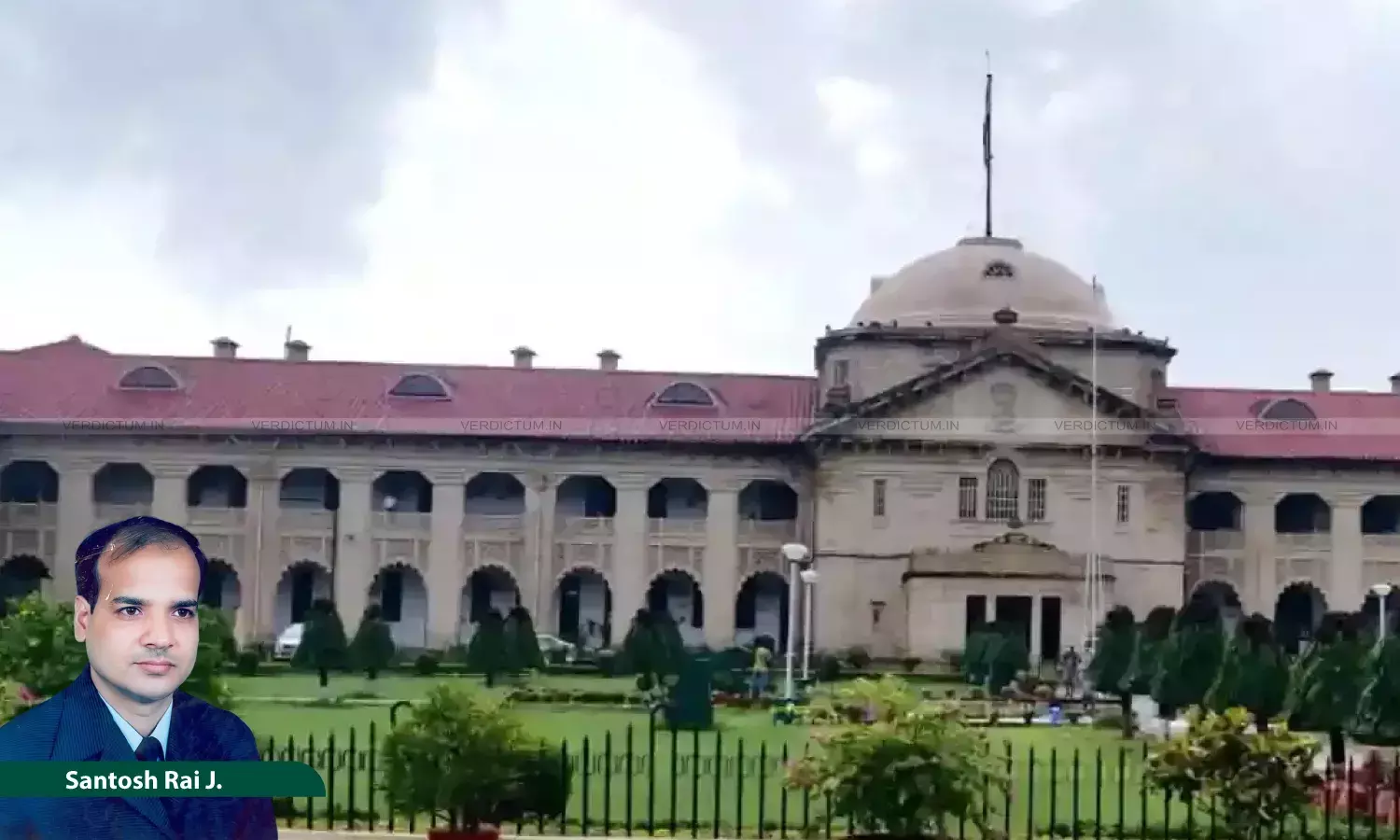
The Allahabad High Court has directed all Judicial Officers in Uttar Pradesh exercising jurisdiction under Sections 173(4), 175(3) and 175(4) of the Bharatiya Nagarik Suraksha Sanhita, 2023 to pass speaking and reasoned orders while deciding applications seeking police investigation.
Issuing eleven statewide directions, the Court held that the statutory power to order investigation must be exercised judicially rather than mechanically and set aside an order directing registration of a case against police personnel.
The Court was hearing a criminal appeal against an order of a Special Judge under the Scheduled Castes and Scheduled Tribes (Prevention of Atrocities) Act, 1989, which had allowed an application under Section 173(4) BNSS and directed registration of a case against a Sub-Inspector, a Constable and other police personnel.
A Bench of Justice Santosh Rai, upon hearing the matter, observed: “The manner in which the learned Special Judge, SC/ST Act, Maharajganj has dealt with the application under Section 173(4) BNSS is a matter of ‘serious concern’. The impugned order reflects a serious lack of appreciation and application of the statutory procedure under the BNSS and the binding principles laid down by the Hon’ble Supreme Court as discussed herein above”.
The Bench accordingly issued a set of directions “for ensuring compliance with the procedural mandates by all the Judicial Officers in the State of Uttar Pradesh”
Advocates Ram Pravesh Yadav and Shashank Kumar appeared for the appellant. Additional Government Advocate Sushil Pandey appeared for the State, while Advocate Pawan Kumar appeared for the private respondents.
Background
The private respondents alleged that police personnel had entered their house during the night following a land and money dispute involving their family, behaved obscenely, outraged their modesty and made caste-based remarks. They sought registration of offences under the Bharatiya Nyaya Sanhita, 2023 and the SC/ST Act.
The Special Judge found that the allegations prima facie disclosed a cognizable offence and directed the police to register a case. The appellant contended that the order had been passed mechanically without considering the police inquiry report, the contemporaneous cross-cases arising from the underlying dispute, the official duties being performed by the police personnel or the safeguards under Sections 175(3) and 175(4) BNSS.
The Court noted that the appellant Sub-Inspector had investigated both cross-cases and that the police report and General Diary entries referred to police action taken on the same day in response to a cognizable offence. The Court clarified that it was not expressing any final opinion on the truth of the allegations but examining whether the Special Judge had followed the mandatory statutory procedure before directing further criminal process.
Court’s Observations
Sections 173(4) And 175(3) Operate Sequentially
The Court, at the outset, held that Section 173(4) BNSS does not itself empower a Magistrate to direct registration of an FIR. The Court explained that the provision gives a remedy to a person whose information has not been registered by the officer in charge of a police station and whose subsequent approach to the Superintendent of Police has also failed to secure registration.
The Court observed: “The judicial power to direct investigation/registration of a case is traceable to Section 175(3) BNSS, which corresponds to the earlier Section 156(3) Cr.P.C. Thus, Sections 173(4) and 175(3) BNSS operate in sequence and are complementary in nature.”
The Court stated that an applicant must ordinarily exhaust the remedies under Section 173 before invoking the Magistrate’s jurisdiction under Section 175(3), subject to the legal requirements governing that power.
Investigation Cannot Be Directed Mechanically
The Court explained that Section 175(3) BNSS consciously departed from the language of Section 156(3) CrPC by requiring the Magistrate to consider an affidavit-supported application, determine whether an inquiry was necessary and consider the submission made by the police officer.
The Court observed: “The additional requirements introduced by Section 175(3) BNSS are therefore substantive procedural safeguards and cannot be treated as an empty formality.”
The Court clarified that the expression “such inquiry as he thinks necessary” gave the Magistrate discretion over the nature, extent and manner of inquiry, but did not permit the Magistrate to ignore the need to apply judicial mind to whether an inquiry was required. The Court added that if no inquiry was conducted, the order directing investigation had to disclose consideration of the statutory requirement and briefly explain why an inquiry was unnecessary.
The Court further stated that considering the police officer’s submission ensured that the court examined both the applicant’s version and the explanation or material concerning the refusal to register the case. The Court held that this promoted informed judicial discretion and prevented an allegation from being mechanically converted into a direction for police investigation.
Supreme Court Precedents Require Judicial Application Of Mind
The Court referred to State of Haryana v. Bhajan Lal (1992), Anil Kumar v. M.K. Aiyappa (2013), Priyanka Srivastava v. State of Uttar Pradesh (2015), Ramdev Food Products Private Limited v. State of Gujarat (2015) and Babu Venkatesh v. State of Karnataka (2022) while examining the requirement that Magistrates apply judicial mind before directing an investigation.
The Court noted that Anil Kumar (2013), following Maksud Saiyed v. State of Gujarat (2008), required the Magistrate’s reasons for ordering an investigation to be reflected in the order. The Court further noted that Priyanka Srivastava (2015) required prior recourse under Sections 154(1) and 154(3) CrPC and an affidavit-supported application to prevent routine or harassing invocation of the Magistrate’s authority.
Referring to Om Prakash Ambadkar v. State of Maharashtra (2026), the Court stated that Section 175(3) BNSS introduced three prominent changes: mandatory prior recourse to the Superintendent of Police, the Magistrate’s power to conduct an inquiry and consideration of the police officer’s submissions before issuing directions.
The Court also relied on XXX v. State of Kerala (2026) for the procedure governing complaints against public servants under Sections 175(3) and 175(4) BNSS, including the distinction between acts bearing a reasonable nexus with official duty and acts wholly unconnected with such duty.
Additional Safeguards Apply To Complaints Against Public Servants
The Court held that Section 175(4) BNSS provides an additional substantive safeguard where a complaint against a public servant arises from the discharge of official duties. The Court stated that the Magistrate must obtain a report containing the facts and circumstances from the public servant’s superior officer and consider the public servant’s assertions regarding the incident.
The Court observed: “The requirement of Section 175(4) BNSS is substantive and cannot be reduced to an empty formality.”
The Court held that Sections 175(3) and 175(4) must be read together. It added that Section 175(4) was not an independent mechanism through which the affidavit, inquiry and police-submission requirements under Section 175(3) could be bypassed.
Special Judge Overlooked Statutory Safeguards
The Court found that the Special Judge had treated the allegations in the application as sufficient without considering the contemporaneous police action, arrests arising from a cognizable case, the cross-cases, the police report or the official status of the proposed accused.
The Court held that the impugned order did not show consideration of the three statutory requirements under Section 175(3): the affidavit-supported application, the necessity of an inquiry and the police officer’s submission. The Court further found no meaningful consideration of the official-duty test under Section 175(4).
The Court stated: “The omission is not a mere procedural irregularity but goes to the very exercise of jurisdiction under Section 175(3) BNSS.”
The Court expressed serious concern over the Special Judge’s handling of the application and held that the order reflected non-application of mind to the BNSS procedure and binding Supreme Court principles.
Statewide Directions Under Sections 173 And 175 BNSS
The Court directed Judicial Officers exercising jurisdiction under Sections 173(4) and 175 BNSS to recognise that the inquiry contemplated by Section 175(3) is a substantive departure from Section 156(3) CrPC. The Court clarified that the object was not to conduct a mini-trial but to ensure that the power to direct an investigation was exercised judicially.
The Court directed Judicial Officers to consider the police report or submission concerning the refusal or failure to register an FIR. The Court added that they must verify whether the applicant followed the statutory course under Section 173 and must not permit an entirely new factual foundation to be introduced after the police declined to register the original information.
The Court directed that Sections 175(3) and 175(4) be read harmoniously. It held that where the alleged act prima facie arose from official duty, Magistrates and Special Courts must follow Section 175(4) and give a brief but clear finding on whether the act bore a reasonable nexus with official duty.
The Court required heightened judicial caution where the proposed accused was a public servant or police officer and the same police establishment had previously registered or investigated a case against the complainant or family, made arrests, taken preventive or coercive action, investigated a case or counter-case, filed a closure report or was otherwise connected with the occurrence.
In such cases, the Court directed examination of the chronology, General Diary entries, FIRs, criminal cases, arrest memos, police reports and other contemporaneous material. The Court clarified that prior police action or criminal cases could not, by themselves, establish either the falsity or the truth of the complaint and were relevant circumstances requiring judicial consideration.
The Court directed that the inquiry under Section 175(3) be confined to what was necessary for the proper exercise of judicial discretion.
The Court further directed that every order under Sections 173(4), 175(3) or 175(4) should ordinarily identify whether Section 173 had been complied with; whether the requisite affidavit accompanied the application; whether the police report had been obtained and considered; whether an inquiry was necessary; the result of any inquiry; and the reasons for dispensing with an inquiry.
The Court added that the order should also address whether Section 175(4) applied, whether the alleged act bore a reasonable nexus with official duty, whether the superior officer’s report and the public servant’s assertions had been considered, and the precise reasons for granting or refusing investigation.
The Court directed that where a superior officer’s report under Section 175(4) was not submitted within a reasonable period, the court need not wait indefinitely. It could proceed under Section 175(3) after considering the accused public servant’s version under Section 175(4)(b), if available.
The Court also directed all Magistrates and Special Courts to strictly follow Om Prakash Ambadkar (2026) and XXX (2026) while exercising jurisdiction under Sections 173(4), 175(3) and 175(4) BNSS.
Directions Do Not Immunise Public Servants
The Court clarified: “These directions are issued not to restrict the legitimate right of an aggrieved person to seek investigation into a cognizable offence, nor to confer immunity upon any public servant, but to ensure that the power to direct investigation is exercised judicially, transparently, fairly and in accordance with the statutory safeguards deliberately incorporated in Section 174 & 175 BNSS and principles laid down by Hon’ble Supreme Court in this regard.”
Conclusion
The Court allowed the appeal, set aside the Special Judge’s order and quashed consequential proceedings arising solely from that order.
The Court directed every District and Sessions Judge in Uttar Pradesh to monitor compliance during monthly meetings of Judicial Officers. It also directed District Monitoring Cells to review implementation during their monthly meetings with officers of the district administration.
The Court directed the Registrar General of the Allahabad High Court to circulate the judgment among all Judicial Officers in Uttar Pradesh for strict compliance and to forward it to the Director of the Judicial Training and Research Institute, Lucknow, for appropriate guidance.
Copies were also directed to be sent to all District Magistrates, Senior Superintendents and Superintendents of Police, and Commissioners of Police in the State for information and necessary compliance.
Cause Title: Rakesh Kumar Yadav v. State of U.P. and 2 Others (Neutral Citation: 2026:AHC:211987)
Appearances
Appellant: Advocates Ram Pravesh Yadav and Shashank Kumar
Respondents: Additional Government Advocate Sushil Pandey; Advocate Pawan Kumar
