

Proper Application Has To Be Made To Trial Judge If Police Officer Is Of Opinion That Further Investigation Is Necessary: Allahabad High Court
The Allahabad High Court was considering the writ petitions seeking quashing of the order passed by the Joint Commissioner of Police.

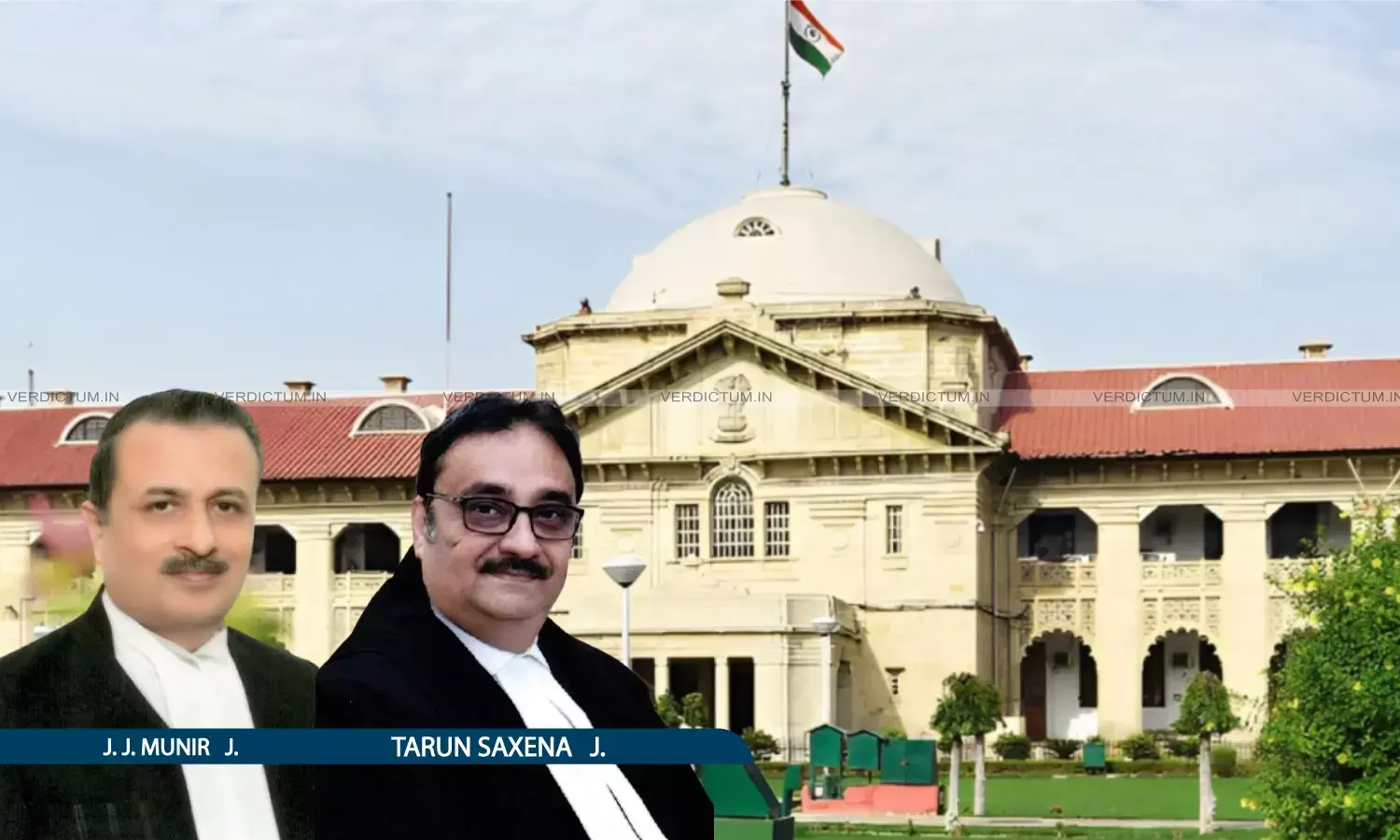
Justice J.J. Munir, Justice Tarun Saxena, Allahabad HC
While quashing an order passed by the Joint Commissioner of Police in a murder case, the Allahabad High Court has held that the Police can further investigate the matter only when a proper application is made by the Joint Commissioner of Police or a Police Officer of any rank to the Trial Judge.
The High Court was considering the writ petitions seeking to quash the order passed by the Joint Commissioner of Police, Crime and Headquarters, Kanpur Nagar in a case registered under Sections 302 and 120-B of the Indian Penal Code, 1860 (IPC).
The Bench of Justice J.J. Munir and Justice Tarun Saxena held, “It goes without saying that if the Joint Commissioner of Police or Police Officer of any rank, having concern with the matter, is of opinion that further investigation is necessary, a proper application has to be made to the Trial Judge and it is only if and after the learned Judge grants permission that the Police can further investigate the matter; not otherwise.”
Advocate Aditya Gupta represented the Petitioner while Advocate Pramod Kumar represented the Respondent.
Factual Background
A First Information Report (FIR) was lodged by a private respondent giving rise to a case under Sections 302 and 120-B of the IPC. The informant/complainant alleged that his father, Rajaraj Verma, was inside his house when he received a phone call on his mobile phone. Upon hearing the phone call, he went out of the house to the main gate. At that time, a shot rang out, and hearing it, the informant and other members of the family rushed towards the gate. The informant and others, who had gone there, saw that two unknown men, with country-made pistols in hand, hurriedly mounted a standing motorcycle and escaped.
The informant's father was lying on the ground injured with a gunshot wound to his temple. The informant, with the assistance of others, conveyed the injured to the Hallet Hospital. The doctors here declared the informant's father dead. It was also said in the FIR that his father had a land dispute with the owners of N.R.I. City and one Raj Bahadur, stretching over a considerable period of time. The informant also said that he had firm faith that these N.R.I. City owners and Raj Bahadur had conspired amongst themselves to get his father murdered. The informant requested necessary action in the matter.
After carrying out a thorough investigation, the Investigating Officer filed a charge-sheet against Dilanyaz under Sections 302, 120-B and 420 IPC, against Rohit Yadav, Ankit Yadav and Ram Khelawan under Sections 302, 120-B IPC, and the investigation against Raj Bahadur and owners of the N.R.I. City was kept pending. An application under Section 319 Cr.P.C. was filed with the prayer to summon Raj Bahadur and Smt. Rekha to face trial. It was the petitioner’s case that the Joint Commissioner of Police passed the impugned order directing further investigation, without taking leave or permission of the Court, where the trial was pending.
Reasoning
The Bench explained that the proviso to sub-section (9) of Section 193 Cr.P.C. places a firm statutory embargo on the power of the Police to further investigate during trial and the embargo is that further investigation can be conducted with permission of the Court trying the case. Referring to the judgment in Pramod Kumar and others v. State of Uttar Pradesh and others, (2026), the Bench stated, “The principles of law adumbrated in Pramod Kumar (supra) leave no manner of doubt that the Police have no power to direct further investigation through the pen of a superior officer unless leave of the Court, trying the case, or even the Magistrate, is obtained for the purpose.”
On a perusal of the facts of the case, the Bench stated that the application of the Investigating Officer was not at all an application seeking permission to further investigation made to the Court. “Rather, it is a very arrogantly worded application, which informs the Court that the Joint Commissioner of Police has already taken a decision to direct further investigation under Section 173(8) Cr.P.C./ 193(9) BNSS, and in compliance with the said direction, the person making the application had been appointed the Investigating Officer”, it added.
The Bench stated that the application was not an application moved by the Investigating Officer to the Court, seeking permission to further investigate the crime on the basis of some information subsequently coming to his knowledge. “It is rather an application conveying to the Court orders of further investigation passed by the Joint Commissioner of Police, with a prayer to facilitate the Investigating Officer applying, in doing his duty of further investigation”, it added.
Thus, quashing the impugned order passed by the Joint Commissioner of Police and allowing the petition, the Bench ordered, “It will be open to the Police to make an application to the learned Trial Judge seeking permission to further investigate the matter, either under the provisions of Section 173(8) Cr.P.C. or 193(9) BNSS, whichever is attracted, and it is only after the learned Judge grants permission that the Police can hold further investigation. It goes without saying that any investigation that has been held so far pursuant to the impugned order passed by the Joint Commissioner of Police, Crime and Headquarters, Kanpur Nagar dated 05.12.2025 would be non est and struck off the record.”
Cause Title: Rakesh Kumar Tiwari v. State of U.P. and others (Neutral Citation: 2026:AHC:160663-DB)
Appearance
Petitioner: Advocates Aditya Gupta, Pranav Tiwary
Respondent: Advocate Pramod Kumar, Government Advocate