

"Still Born" UP Gangsters Act Continues To Be Operative: Allahabad High Court Quashes FIR In Saharanpur Liquor Case
The Allahabad High Court was considering the petition whereby the accused sought quashing of an FIR registered under the Uttar Pradesh Gangsters and Anti Social Activities (Prevention) Act, 1986.

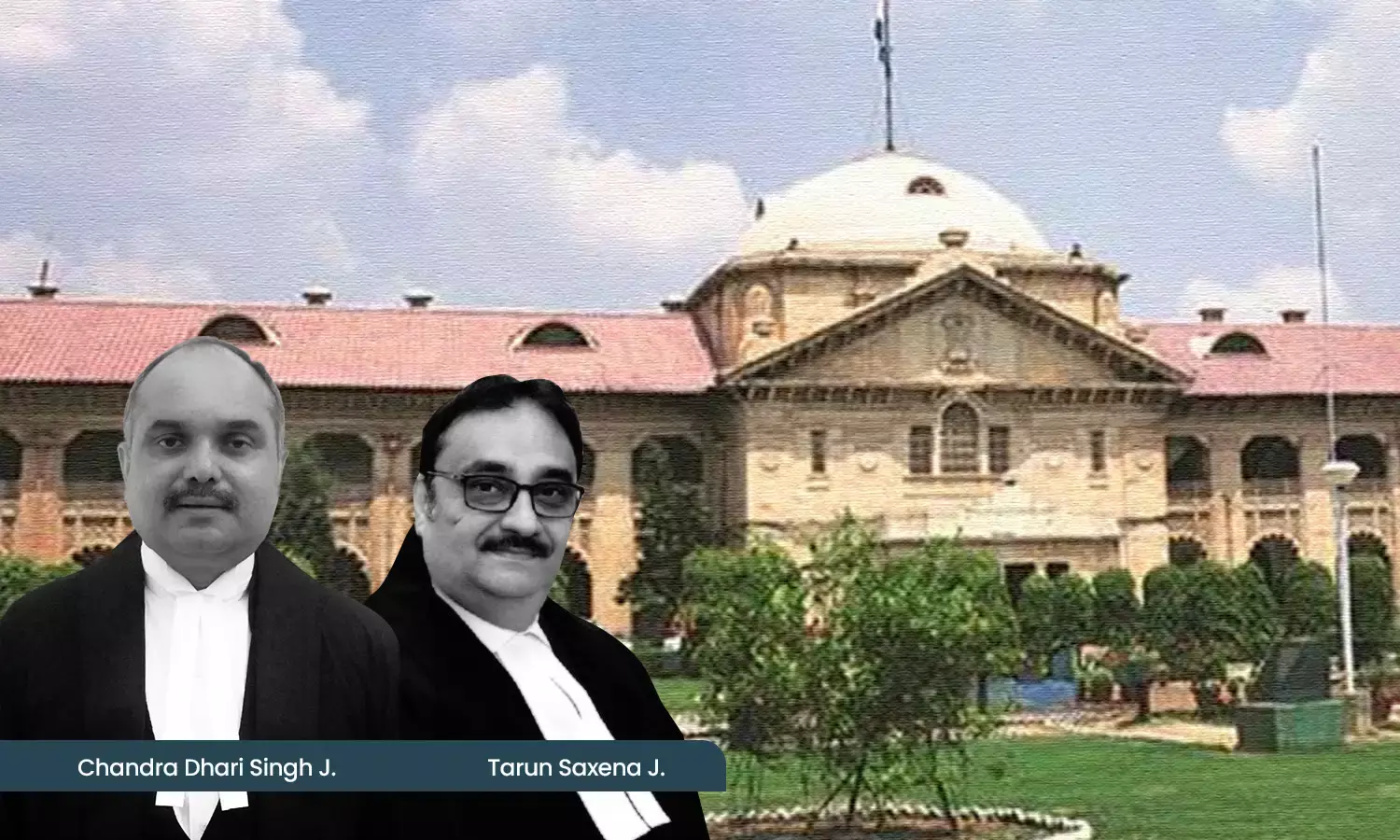
While quashing the FIR against 4 accused persons in the Saharanpur Liquor Case, the Allahabad High Court has issued 12 binding directions to be followed in order to secure compliance with the provisions of the Uttar Pradesh Gangsters and Anti-Social Activities (Prevention) Act, 1986. The High Court has also clarified that the Uttar Pradesh Gangsters and Anti-Social Activities (Prevention) Act continues to be operative.
The High Court was considering the writ petitions filed under Article 226 of the Constitution, which arose from the same first information report and the same gang chart. The petitioners sought quashing of an FIR registered under Sections 2(b)(i), 3(1) and 3/2 of the Uttar Pradesh Gangsters and Anti Social Activities (Prevention) Act, 1986, together with the gang chart and all consequential proceedings.
The Bench comprising Justice Tarun Saxena and Justice Chandra Dhari Singh held, “The Act continues to be operative, as held under Question (i).”
“Before a gang chart is prepared, the officer preparing it shall record, for each person, the following particulars, together with the material for each: (a) the clause of Section 2(b) being invoked; (b) the means of violence, threat, show of violence, intimidation or coercion attributed to that person; and (c) the object alleged”, it added.
The directions include aspects of threshold determination, individual assessment recording of specific reasons for ordinary prosecution being inadequate, mentioning of date of the last act attributed to each person in the gang chart, full disclosure in the chart, recording of minutes of joint meeting, independent and dated satisfaction, reckoning of base cases, recording of reasons for public authorities, details on production before Court.
Senior Advocate Subir Lal represented the Petitioner, while Government Advocate represented the Respondent.
Factual Background
The FIR named 27 persons, out of whom one Pranay Aneja was described as the gang leader. Ashwani Upadhyay Upendra, Govind Rao, and Ravindra Kishor were shown as members. Co-operative Company Limited held a PD-2 licence for the manufacture of country liquor at its unit at Yusufpur Tapri, District Saharanpur. A joint team of the Excise Department and the Special Task Force intercepted a container truck carrying 1,500 cases of country liquor from that unit. The allegation was that the truck was on a second trip for a single consignment to a CL-2 wholesale licensee at Unnao. Duty was allegedly paid on one consignment while two were removed. Two FIRs were registered under Section 60 of the U.P. Excise Act, 1910, and Sections 420, 467, 468, 471 and 477-A IPC. 16 persons were named, including Pranay Aneja, Upendra Govind Rao and Ashwani Upadhyay. Ravindra Kishor was not named.
The petitioners asserted that the unit was sealed on March 3, 2021, and no manufacturing or commercial activity had taken place there since. The investigation was entrusted to the State Special Investigation Team. In December 2025, the Inspector-in-charge, Police Station Kotwali Dehat, Saharanpur, prepared a gang chart naming 27 persons, as against the 9 originally recommended. The Inspector-in-charge excluded two persons, namely Rakesh Ahuja and Mayur Ahuja. 20 other persons were added, including company employees, transporters, liquor licensees and four excise officials, including Ravindra Kishor. The gang chart referred to only one criminal case against all twenty-seven persons, and all were shown to be on bail and active across districts.
Reasoning
The Bench explained that Section 111(1) defines organised crime as any continuing unlawful activity, including economic offences, carried on by a person or group acting as or on behalf of an organised crime syndicate, by violence, threat, intimidation, coercion or other unlawful means, to obtain material benefit. However, the Bench held that Section 111 did not apply here, since the acts alleged predate it, and Article 20(1) barred its retrospective application. “We refer to it only because it shows what Parliament has regarded as the essential safeguards of a law on organised crime, viz. - a statutory offence, a threshold demonstrable from court records, and the elements of force or unlawful means and of benefit”, it added.
Referring to the judgment in Ashok Kumar Dixit v. State of U.P. (1987), the Bench observed that since the constitutionality of the Uttar Pradesh Gangsters and Anti-Social Activities (Prevention) Act, 1986 had not been decided, the Act remains on the statute book and carries the presumption of constitutionality. Reference was also made to the judgment in Shiv Pratap Singh v. State of U.P. (2026), wherein the Act has been held to be stillborn.
The Bench further noted that the only incident was that of March 3, 2021, and the unit had been sealed since that day. It was noticed that the gang chart was prepared four years and nine months later. “Nothing falling within Section 2(b) is alleged against any petitioner in the intervening period. The FIR gives the date and place of occurrence as “various”. In the meantime, the base case has been chargesheeted ten times, cognizance has been taken, and each petitioner has been admitted to bail”, it added.
The Bench was of the view that the allegations disclosed offences which were already being prosecuted in the base case. They did not disclose the activity of a gang within Section 2(b) read with Rule 3 and the records furnished no basis for invoking the Act nearly five years after the solitary incident. The Bench further held that the satisfaction required by Rules 5(3)(a), 16 and 17 of the Uttar Pradesh Gangsters and Anti-Social Activities (Prevention) Rules, 2021 is a jurisdictional condition for registering an FIR under the Act and its absence goes to the root of the proceeding and is not a curable irregularity.
Thus, allowing the Petitions, the Bench quashed the FIR, gang chart on which it was founded, and all the proceedings consequential thereto qua the petitioners Pranay Aneja, Ashwani Upadhyay, Upendra Govind Rao and Ravindra Kishor. “Nothing in this judgment shall affect Case No. 881 of 2021 pending before the learned Special Judge, P.C. Act, CBI (Central), Lucknow, the proceedings under the Prevention of Money Laundering Act, 2002, or any departmental proceedings against Ravindra Kishor. Those proceedings shall continue in accordance with law, uninfluenced by any observation made herein”, it clarified.
Cause Title: Pranay Aneja v. State of U.P. and 4 others (Neutral Citation: 2026:AHC:236800-DB)
Petitioner: Senior Advocate Subir Lal, Atul Khaneja, Advocate Ram Prakash
Respondent: Government Advocate