

Subsequent Divorce Decree Does Not Absolve Husband Of Liability For Domestic Violence Once Committed: Allahabad High Court
The Court held that a woman can invoke the Domestic Violence Act for acts related to a past domestic relationship, and proceedings cannot be quashed by conducting a mini-trial merely because divorce has subsequently been decreed.
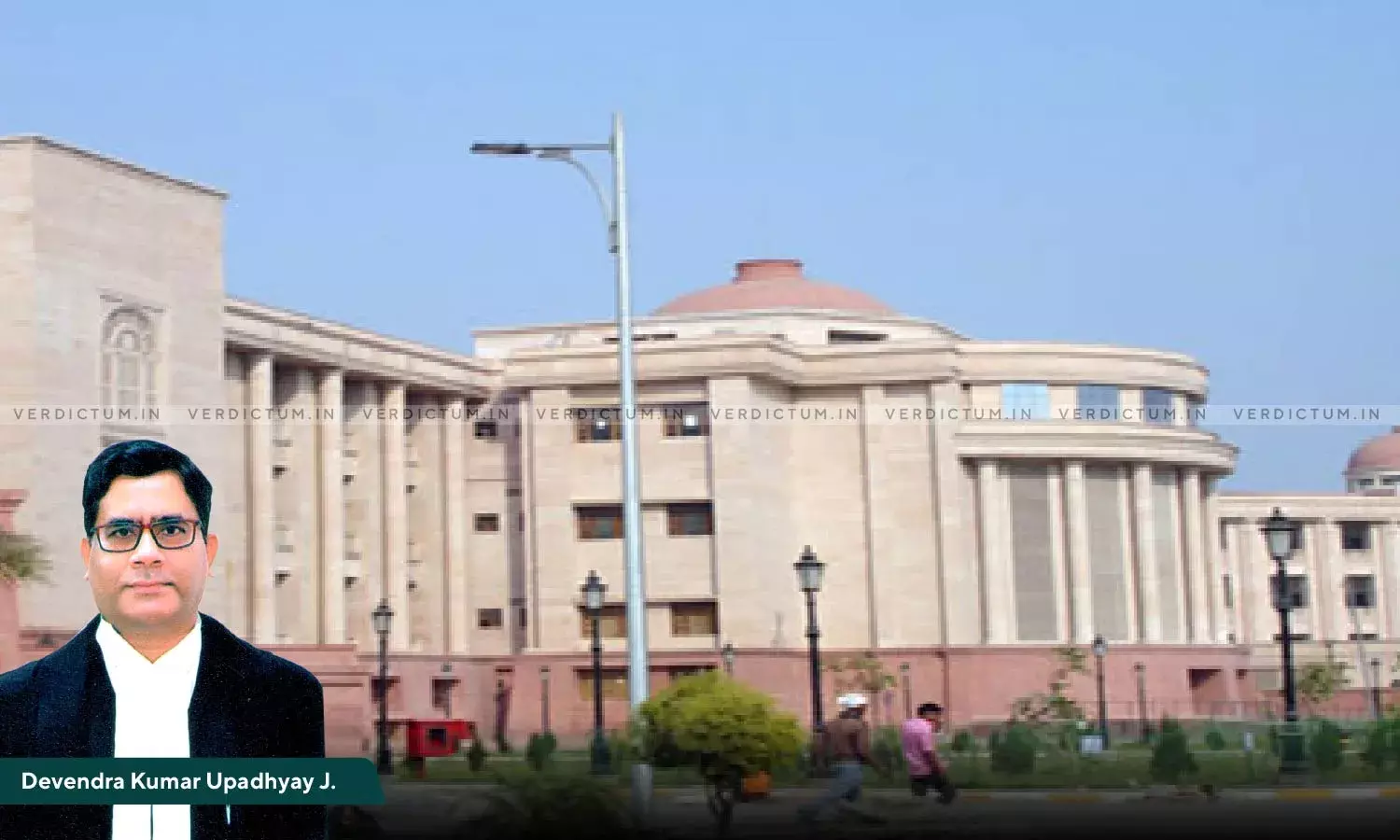
Justice Brij Raj Singh, Allahabad High Court
The Allahabad High Court has held that a subsequent decree of divorce will not absolve the husband of liability for an act of domestic violence once committed, or deny the aggrieved wife the benefits to which she may be entitled under the Protection of Women from Domestic Violence Act, 2005.
The Court was hearing an application filed under Section 482 Cr.P.C. seeking quashing of proceedings initiated under Section 12 of the Domestic Violence Act, on the ground that the applicant’s divorce petition had already been decreed in his favour.
A Bench of Justice Brij Raj Singh observed: “An act of domestic violence once committed, subsequent decree of divorce will not absolve the liability of the husband from the offence committed or to deny the benefit to which the aggrieved person is entitled under the Domestic Violence Act, 2005. There is provision of monetary relief under Section 20, child custody under Section 21, compensation under Section 22 and interim or ex-parte order under Section 23 of the Domestic Violence Act, 2005. All these issues can be decided after adducing the evidence on record but at this stage, this Court cannot do mini trial and quash the entire proceedings on the ground that suit for divorce has been decreed in favour of the applicant.”
Advocate Soma Pandey appeared for the applicant, while Advocate Katyayan Mishra appeared for the respondents.
Background
The applicant sought quashing of the complaint proceedings under the Domestic Violence Act, contending that the allegations raised by the wife in the domestic violence proceedings were identical to those raised in matrimonial proceedings, which had already been adjudicated by the Family Court.
It was submitted that the applicant’s divorce petition under Section 13 of the Hindu Marriage Act, 1955, had been allowed on the ground of cruelty, while the wife’s proceedings for restitution of conjugal rights and return of stridhan had been dismissed. The applicant argued that the wife could not be permitted to re-litigate the same allegations under the Domestic Violence Act and that no subsisting domestic relationship survived after the dissolution of the marriage.
The opposite party no.2 opposed the application, alleging mental and physical cruelty, retention of jewellery and domestic violence within the meaning of Section 3 of the Act. It was submitted that the parties had lived in a domestic relationship and that the remedies under the Domestic Violence Act could not be defeated merely because divorce had subsequently been granted.
Court’s Observations
The High Court first considered the applicant’s reliance on Inderjit Singh Grewal v. State of Punjab (2011), where the Supreme Court had quashed domestic violence proceedings in the factual backdrop of a subsisting decree of divorce. The Court noted that the Supreme Court had observed that while complaints are ordinarily tested on their face value, continuation of proceedings in the facts of that case would amount to abuse of process.
The Court then referred to Shaurabh Kumar Tripathi v. Vidhi Rawal (2025), where the Supreme Court held that proceedings arising out of an application under Section 12 of the Domestic Violence Act can be challenged under Section 482 Cr.P.C., but High Courts must exercise caution and circumspection while dealing with such applications.
The Court noted that the Supreme Court in Shaurabh Kumar Tripathi (2025) had clarified that interference under Section 482 Cr.P.C. in domestic violence proceedings would ordinarily be warranted only in cases of gross illegality or injustice.
The Bench thereafter considered Prabha Tyagi v. Kamlesh Devi (2022), where the Supreme Court held that a domestic relationship has to be interpreted broadly and includes not only persons presently living together in a shared household, but also those who have lived together at any point of time in such a household.
The Court noted that in Prabha Tyagi (2022), the Supreme Court had held that judicial separation does not put an end to marriage and, therefore, the domestic relationship continues between spouses even if they are not actually living together. It further noted that even after divorce, if acts of domestic violence are related to the period of the domestic relationship, the aggrieved woman can avail remedies under the Domestic Violence Act.
The Bench also relied on Juveria Abdul Majid Patni v. Atif Iqbal Mansoori (2014), where the Supreme Court held that a subsequent decree of divorce does not absolve liability for domestic violence once committed, nor does it deny the aggrieved person remedies such as monetary relief, custody, compensation or interim orders under the Domestic Violence Act.
The Court observed that the view taken in Prabha Tyagi (2022) was followed by a coordinate Bench of the High Court in Shashank Pandey v. State of U.P. (2024), where it was held that even where marriage was subsequently declared null and void, the woman could still be treated as an aggrieved person if the relationship had subsisted like marriage and the parties had lived in a domestic relationship.
Applying these principles, the High Court noted that it was not in dispute that the applicant and opposite party no.2 were married and had shared a household during the marriage. The Court held that the definition of domestic relationship under Section 2(f) of the Domestic Violence Act is expansive and includes a relationship between two persons who live or have, at any point in time, lived together in a shared household.
The Bench held that the wife could claim protection under the Domestic Violence Act because the statute recognises past domestic relationships and does not confine relief only to women presently residing with the respondent in a shared household.
The Court further held: “The wife is eligible to claim protection under the Domestic Violence Act because the definition of domestic relationship as provided under Section 2(s) of the Domestic Violence Act includes not only a relationship between two persons who presently live together in a shared household, but also extends to persons who have, at any point of time lived together in a shared household. The judicial separation ordered by a court of law does not put an end to marriage and, hence, the domestic relationship continues between the wife and husband even though they may not be actually living together.”
The Court also noted that reliefs under Sections 20, 21, 22 and 23 of the Domestic Violence Act, including monetary relief, child custody, compensation and interim or ex parte orders, are issues that require evidence. It held that such questions cannot be decided at the stage of a quashing petition by conducting a mini-trial.
The Bench therefore rejected the argument that the entire domestic violence proceedings should be quashed solely because the divorce petition had been decreed in favour of the applicant.
Conclusion
The Allahabad High Court held that the applicant had failed to make out a case for quashing the domestic violence proceedings under Section 482 Cr.P.C.
The Court dismissed the application as devoid of merit and made no order as to costs.
Cause Title: PR v. State of U.P. through Principal Secretary Home, Lucknow And Another (Neutral Citation: 2026:AHC-LKO:43629)
Appearances
Applicant: Advocates Soma Pandey, Mukul Sudhir Pandey, Shashank Dwivedi and Shashi Dwivedi.
Respondents: G.A., Advocates Gaurav Kumar Hasani, Katyayan Mishra, Lovekush Pandey and Santosh Kumar Pandey.
