

Used Proposed Supreme Court Challenge As Pretext To Avoid Implementing Police Investigation Reforms: Allahabad High Court Pulls Up ACS (Home)
The Court questioned ACS (Home) Sanjay Prasad’s conduct over non-implementation of Subhash Chandra investigation reforms; directed order to be sent to DoPT for consideration in future assignments.

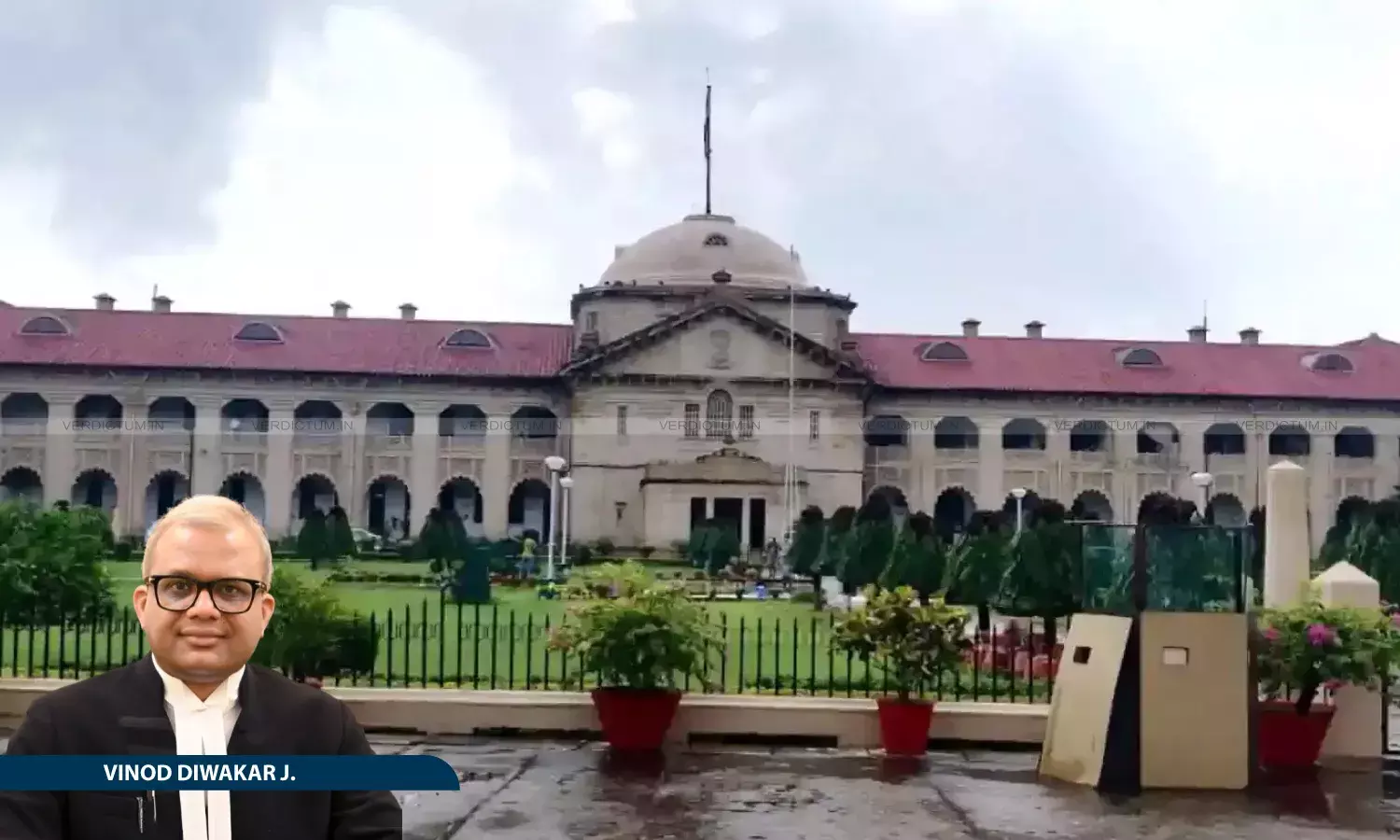
Justice Vinod Diwakar, Allahabad High Court
In a judgment that goes far beyond the recovery of a missing minor girl, the Allahabad High Court has raised fundamental concerns about bureaucratic resistance to police reforms and recommended to the Secretary, DoPT for the evolution of a "superior responsibility" doctrine under which senior civil servants may be held accountable for failing to prevent or act against misconduct, negligence, corruption, or non-implementation of government policies by their subordinates.
The Court found that the ACS Home had allowed directions for police investigation reforms issued in Subhash Chandra & Others v. State of U.P. & Another (2025) SCC OnLine All 3029 to remain unimplemented for nearly a year, and disclosed the State's intention to challenge the judgment before the Supreme Court only after the Court raised the question of non-compliance, thereafter using the proposed SLP as a basis to seek restraint of enforcement without pursuing it with any diligence or bona fides.
Justice Vinod Diwakar pertinently, disposed of the petition, as the minor girl had been recovered and restored to her parents pursuant to efforts by the SSP Jhansi and the police team. The Bench, however, observed, “As deliberated in foregoing paragraphs, it appears that the directions issued in Subhash Chandra (supra) were the product of an extensive consultative process involving the police establishment, the prosecution department, and the Home Department itself. Notwithstanding the aforesaid, the said directions were not complied with for a period of nearly a year after their issuance. It was only upon this Court specifically raising the issue of non-compliance by order dated 11.02.2026 that a Secretary of the Home Department, even though he was not called upon, filed an affidavit dated 20.02.2026, for the first time intimated the intention of the ACS (Home) to challenge the judgment before the Supreme Court, and no order or any document produced before this Court till the signing of the judgment that the Supreme Court has taken cognizance of the directions issued in Subhash Chandra (supra), even after lapse of more than three months…”.
Advocates Raghvendra Yadav and Jay Prakash Singh Yadav appeared for the petitioner and M.C. Chaturvedi, Additional Advocate General, Vibhav Anand Singh, AGA appeared for the respondents.
In the matter, the petitioner, the mother of a 15-year-old minor girl, filed a habeas corpus petition before the Allahabad High Court after her daughter was allegedly enticed away on June 10, 2025.
An FIR was registered under Sections 87 and 137(2) of the Bharatiya Nyaya Sanhita, 2023, and the accused was arrested and a charge sheet was filed on August 13, 2025, within approximately 60 days, without arraying the real accused and without compliance with the detailed directions issued by the Court in Subhash Chandra, which prescribed comprehensive standards for quality of investigation, charge sheet preparation and mandatory prosecutorial review.
The Court, noting serious concerns about the investigation, called for personal affidavits from the SSP Jhansi and subsequently directed examination of ten charge sheets from ten different districts to assess whether the Subhash Chandra directions were being followed across the State.
The Court found, upon examination of the ten charge sheets, that the directions in Subhash Chandra had not been uniformly adhered to and disclosed a pattern of systemic non-compliance.
The Court directed the Additional Chief Secretary Home to file a personal affidavit explaining persistent non-compliance. Instead, the Secretary Home filed an affidavit on February 20, 2026 stating that the Home Department had decided to challenge Subhash Chandra before the Supreme Court on the ground that certain directions regarding pre-submission prosecutorial review of charge sheets raised substantial questions of law.
The State sought that the Court refrain from further enforcement pending the Supreme Court's consideration. The Court waited for three months but no Supreme Court order was produced before it.
The Court drew a firm distinction between departmental grievance and personal satisfaction as motives for litigation, and observed that unbridled administrative discretion carried serious risks, undermining the rule of law, serving as a source of illicit power, relieving officers of accountability, and amounting in practice to discrimination.
“This Court has given its anxious consideration to the question as to why the implementation of police reforms and investigative safeguards has repeatedly encountered resistance at the administrative level. The record placed before the Court indicates that, on more than one occasion, judicial initiatives intended to strengthen the quality, fairness, and accountability of criminal investigations have not received the degree of institutional support that would ordinarily be expected from the authorities entrusted with civil administration. It is not for this Court to speculate upon the motives of any individual officer or department. However, the sequence of events noticed hereinabove raises legitimate concerns regarding the apparent reluctance of the incumbent ACS (Home)…”, the Bench remarked.
“The conduct of Shri Sanjay Prasad, as noticed above, prima-facie reflects a deliberate and calculated attempt to undermine the authority of this Court by projecting the proposed Special Leave Petition as a basis for seeking restraint in the enforcement of judicial directions, while simultaneously failing to pursue the said remedy with any degree of diligence or bona fides. Such conduct, if left unaddressed, would have the effect of rendering the orders of Constitutional Courts nugatory at the hands of recalcitrant administrative officers and would set a pernicious precedent for the manner in which judicial directions concerning accountability and police reforms may be treated by the executive. This Court cannot be a silent spectator to such conduct”, the Bench observed.
Cause Title: Megha Raikwar v. State of U.P. and 4 Others (Neutral Citation: 2026:AHC:124916)
Appearances:
Petitioner: Jay Prakash Singh Yadav and Raghvendra Yadav, Advocates.
Respondents: M.C. Chaturvedi, Additional Advocate General, Vibhav Anand Singh, AGA.