

“Non-Application Of Mind At The Highest Level”: Allahabad High Court Imposes ₹10L Costs On State For Prolonging Illegal Incarceration
The Court declared the petitioner’s arrest illegal for non-compliance with the constitutional requirement of furnishing grounds of arrest in writing and imposed exemplary costs upon the State.
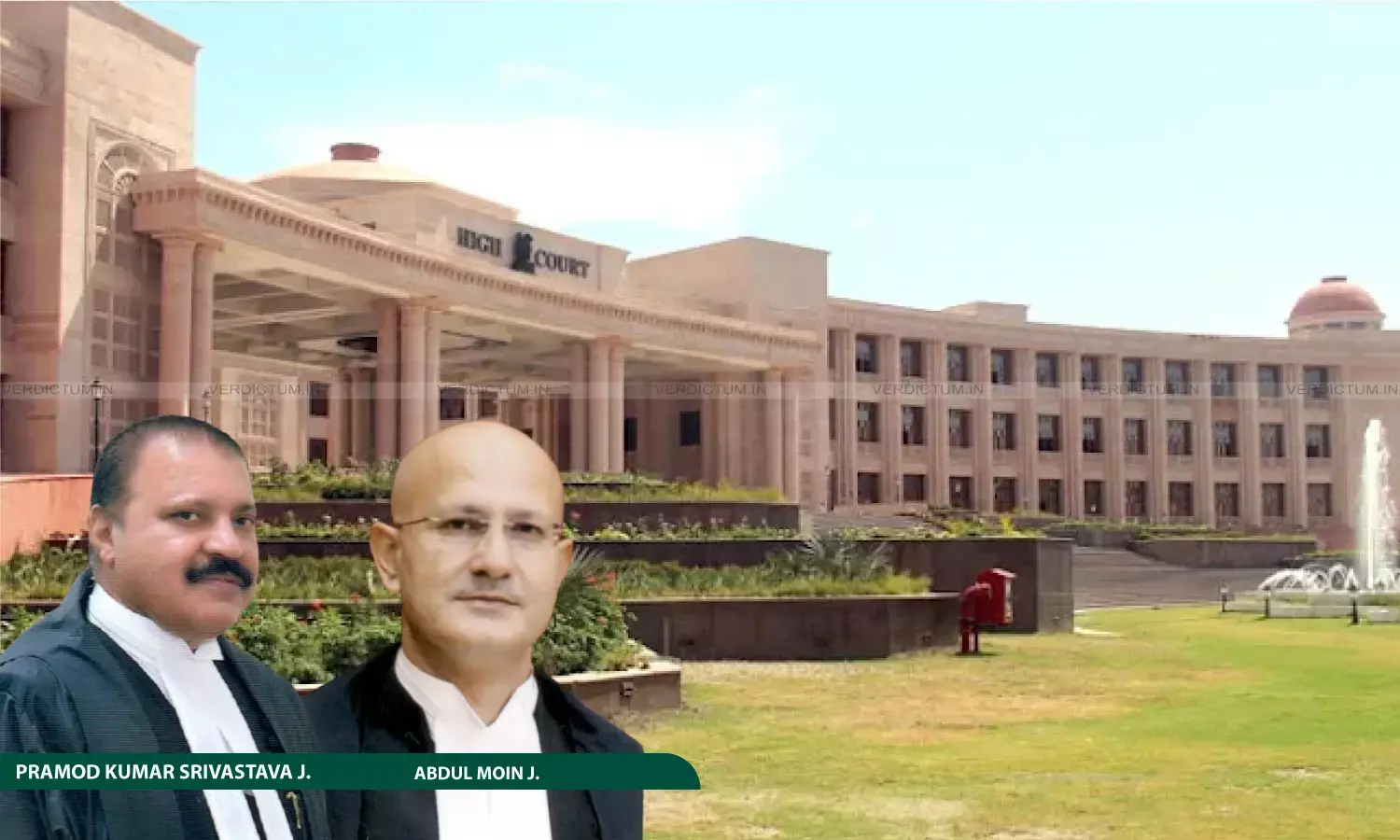
Justice Pramod Kumar Srivastava, Justice Abdul Moin, Allahabad HC (Lucknow-Bench)
The Allahabad High Court imposed costs of ₹10 lakhs upon the State of Uttar Pradesh after declaring the arrest and continued incarceration of a man illegal for violation of Article 22(1) of the Constitution, while strongly criticising the Additional Chief Secretary (Home) for failing to even address the Court’s direction seeking an explanation as to why exemplary costs should not be imposed.
The Court was hearing a habeas corpus petition challenging the legality of the petitioner’s arrest and remand on the ground that the mandatory constitutional requirement of furnishing written grounds of arrest had not been complied with, despite the law laid down by the Supreme Court in Mihir Rajesh Shah v. State of Maharashtra (2025).
A Division Bench of Justice Abdul Moin and Justice Pramod Kumar Srivastava observed: “… the personal affidavit of the Additional Chief Secretary (Home) indicates that appropriate action is being taken or shall be taken after receipt of the report, and the personal affidavit does not even contain a whisper regarding the explanation as to why exemplary cost should not be imposed. If this is the non-application of mind at the end of the highest authority of the Home Department, i.e. Additional Chief Secretary (Home), we can well understand as to how the other authorities of the State are working”.
Further, considering the illegal incarceration of the petitioner for more than three months, the Court imposed “exemplary costs quantified at Rupees Ten Lakhs” on the State authorities.
Advocates Akhilesh Kumar Tripathi and Prashant Tiwari appeared for the petitioner. The State was represented by the Government Advocate.
Background
The petitioner approached the High Court through a habeas corpus petition challenging his arrest and detention in connection with a criminal case registered in 2024. He specifically challenged the legality of the arrest as well as the consequential remand order passed thereafter.
The petitioner contended that although he had been arrested in January 2026, the arrest memo merely mentioned the case crime number and did not disclose the grounds of arrest in writing as constitutionally mandated under Article 22(1).
Reliance was placed upon the Supreme Court judgments in Mihir Rajesh Shah v. State of Maharashtra (2025) and Dr Rajinder Rajan v. Union of India (2026), wherein the Apex Court held that furnishing written grounds of arrest is a binding constitutional safeguard and that failure to comply with the requirement renders the arrest and subsequent remand illegal.
By an earlier order, the High Court had already recorded a prima facie finding that the petitioner’s arrest was illegal and had directed the Additional Chief Secretary (Home) to explain why exemplary costs should not be imposed for the petitioner’s incarceration for nearly three months.
When the matter was taken up again, the State produced a personal affidavit of the Additional Chief Secretary (Home).
Court’s Observation
The High Court noted that despite the specific judicial direction requiring an explanation regarding the imposition of exemplary costs, the affidavit filed by the Additional Chief Secretary (Home) merely stated that reports had been sought from the Director General of Police and that the matter was under consideration.
The Court observed that the affidavit did not even contain “a whisper” explaining why exemplary costs should not be imposed upon the State authorities for the petitioner’s illegal incarceration. The Bench remarked that the Additional Chief Secretary (Home) appeared not to have even gone through the Court’s earlier order directing him to explain the illegal detention of the petitioner for almost three months.
The Court further observed that despite its earlier order, the petitioner continued to remain in jail and the State authorities had “failed to wake up from their slumber.” Reiterating the law laid down in Mihir Rajesh Shah, the Court observed that communication of grounds of arrest is not a procedural formality but a constitutional safeguard flowing from Articles 21 and 22 of the Constitution.
The Bench noted that the Supreme Court had repeatedly held that if written grounds of arrest are not furnished, the arrest itself becomes unconstitutional, and continued custody based upon such arrest also stands vitiated. The Court observed that the arrest memo in the present case merely referred to the case crime number without disclosing any actual grounds of arrest.
The Bench also relied upon the Supreme Court judgment in Rini Johar v. State of Madhya Pradesh (2016), where compensation was awarded for illegal arrest and violation of procedural safeguards.
Quoting from Rini Johar, the Court reiterated: “The freedom of an individual has its sanctity. When the individual liberty is curtailed in an unlawful manner, the victim is likely to feel more anguished, agonised, shaken, perturbed, disillusioned and emotionally torn.”
The High Court observed that the petitioner had lost his personal liberty not because of any lawful procedure but because the authorities had failed to follow constitutional safeguards mandated by the Supreme Court.
Conclusion
The Allahabad High Court allowed the habeas corpus petition and issued a writ declaring the petitioner’s arrest illegal. The consequential remand order was also set aside.
The Court directed that the petitioner be released forthwith, provided he was not wanted in any other case, while clarifying that it would remain open to the authorities to proceed in accordance with law.
Considering the petitioner’s illegal incarceration for more than three months, the Court imposed exemplary costs quantified at ₹10 lakhs upon the State authorities.
The Bench directed that the amount shall initially be paid by the State Government with liberty to recover the same from the officials responsible in accordance with law. The compensation was directed to be paid within four weeks.
Cause Title: Manoj Kumar Through Mudit Kumar v. State of U.P. Through Principal Secretary Home Department & Ors. (2026:AHC-LKO:31073-DB)
