

Attempted Rape Of Accused’s Daughter Led To Fight; No Premeditation To Commit Murder: Allahabad High Court Alters Conviction To Culpable Homicide
The Court held that the absence of premeditation, coupled with a sudden quarrel and lack of cruelty or undue advantage, would bring the case within culpable homicide not amounting to murder.
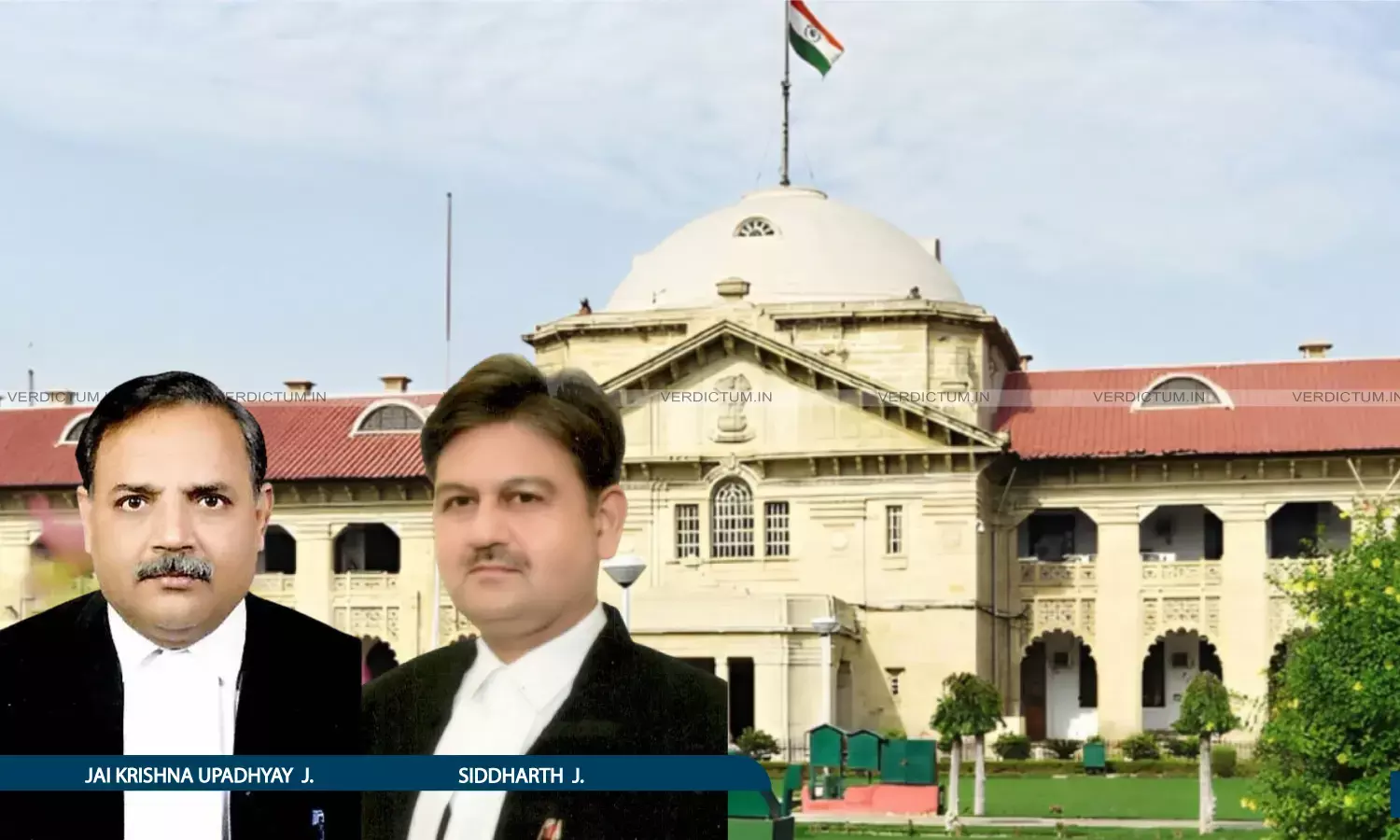
Justice Siddharth, Justice Jai Krishna Upadhyay, Allahabad High Court
The Allahabad High Court, while reducing a conviction from murder to culpable homicide not amounting to murder, observed that the incident had occurred in the course of a sudden fight arising out of an attempt by the deceased to commit rape upon the daughter of the accused, and in the absence of any premeditation, the case would fall within Exception 4 to Section 300 IPC.
The Court was hearing criminal appeals challenging the conviction of the appellants under Sections 302/149 IPC arising out of a homicide incident in which the deceased sustained firearm and multiple injuries at the residence of the accused.
A Division Bench of Justice Siddhartha Varma and Justice Jai Krishna Upadhyay, upon hearing the matter and examining the relevant material placed on the record, observed: “The offence has been committed by the accused appellants as the deceased was attempting to commit rape with the daughter/sister of the appellants but this goes to show that in the heat of passion upon a sudden quarrel followed by a scuffle the accused persons had caused injuries on the deceased. Thus, in our view, in the present case, it cannot be said that the appellants had premeditation to commit the murder of the deceased. If the intent was to murder the deceased, they would not have done so at their own house”.
The Bench accordingly held: “In the aforesaid circumstances, we are of the considered view that it is a case of culpable homicide not amounting to murder within the ambit of Exception 4 of Section 300 IPC”.
Advocate Ritesh Singh appeared for the appellants; AGA Ravindra Sharma appeared for the respondents.
Background
The prosecution case arose from an incident in which the deceased had visited the residence of the accused following a telephonic call regarding repayment of money allegedly lent to them. Upon reaching the premises, an altercation ensued, culminating in the deceased being assaulted with sharp-edged weapons and firearm injuries, leading to his death.
An FIR was registered under Sections 147, 148, 149, and 302 IPC. Upon completion of the investigation, charge-sheets were filed, and the Trial Court convicted the appellants under Section 302/149 IPC and other allied provisions, sentencing them to life imprisonment.
The appellants challenged the conviction, contending, inter alia, that the incident occurred suddenly without premeditation and at best constituted culpable homicide not amounting to murder.
Court’s Observation
The Court undertook a comprehensive evaluation of the evidence on record, including the ocular testimony of prosecution witnesses, medical evidence, and the defence version, and found that the presence of the accused and the factum of homicidal death stood established beyond a reasonable doubt. It noted that the testimonies of eyewitnesses were consistent and corroborated by the post-mortem report, which revealed multiple injuries, including firearm wounds.
However, the Court proceeded to examine the crucial question of whether the offence amounted to murder under Section 302 IPC or culpable homicide not amounting to murder. In this context, it analysed the surrounding circumstances, including the genesis of the incident, the conduct of the parties, and the absence of prior planning.
The Court took note of the defence version that the deceased had forcibly entered the house and attempted to commit sexual assault on the daughter of the accused, which led to a sudden scuffle. It was observed that even as per the prosecution case, the incident was preceded by an altercation at the residence of the accused and escalated into violence on the spur of the moment.
Referring to the principles governing Exception 4 to Section 300 IPC, the Court reiterated that for its applicability, it must be shown that the act was committed without premeditation, in a sudden fight, in the heat of passion, and without the offender having taken undue advantage or acted cruelly or unusually.
“In this case, the evidence sans the element of intent to murder the deceased, … the appellants did not take any undue advantage nor acted in a cruel or unusual manner”, the Bench remarked.
The Court relied upon precedents including Surinder Kumar v. Union Territory, Chandigarh (1989) and Ghapoo Yadav v. State of M.P. (2003) to reiterate that the number of injuries is not determinative and that the decisive factors are the nature of the occurrence and the absence of cruelty or undue advantage.
It also referred to Pulicherla Nagaraju v. State of Andhra Pradesh (2006) to emphasise that intention must be gathered from surrounding circumstances such as the nature of the weapon, manner of assault, and presence or absence of premeditation.
Applying these principles to the facts of the case, the Court found that the incident occurred at the residence of the accused during a sudden altercation and that there was no material to indicate prior planning or intent to commit murder.
“On overall scrutiny of the facts and circumstances of the present case coupled with the evidence as have come on record and the principles laid down by the Hon’ble Supreme Court in the aforesaid cases, we are of the considered opinion that the offence would be one punishable under Section 304 (Part-I)/149 of the IPC in view of the fact that the injuries were found to be sufficient in the ordinary course of nature to cause his death but same were caused in a sudden fight in the heat of passion upon a sudden quarrel, hence the instant case falls under the Exception 4 to Section 300 of IPC”, the Court concluded.
Conclusion
The High Court partly allowed the appeals and altered the conviction of the appellants from Section 302/149 IPC to Section 304 Part I read with Section 149 IPC.
The appellants were sentenced to the period already undergone, while the fine imposed and default sentences were left undisturbed.
Cause Title: Mahesh Singh & Ors. v. State of Uttar Pradesh
