

Eyewitness Need Not Sign Inquest Report Or Recovery Memos To Prove Presence At Crime Scene: Allahabad High Court
The Court held that there is no legal requirement that an eyewitness present at the spot during inquest proceedings must sign the inquest report or recovery memos to establish his presence or prove that he had witnessed the incident.
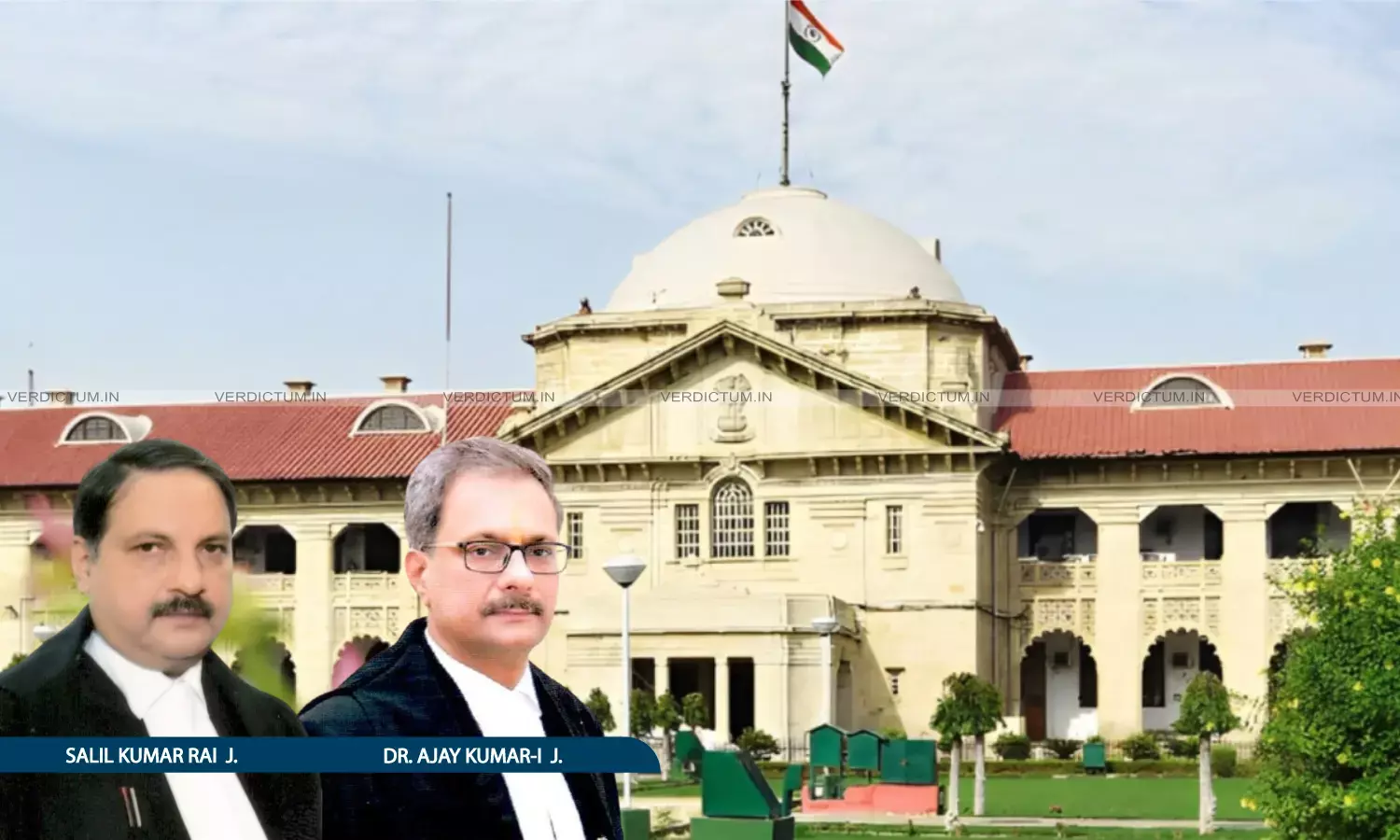
The Allahabad High Court has upheld the conviction of the surviving appellant in a murder case, holding that the testimony of eyewitnesses could not be discarded merely because they had not signed the inquest report or other police papers prepared at the spot.
The Court was hearing a criminal appeal filed against the judgment of conviction passed by the Trial Court under Section 302 read with Section 34 IPC and Section 4/25 of the Arms Act.
A Division Bench of Justice Salil Kumar Rai and Justice Dr. Ajay Kumar-II observed: “There is no requirement of law that an eyewitness, who if present on the spot at the time of inquest proceedings, is required to sign the inquest report and other recovery memos so as to prove his presence on the spot as well as to prove that he is an eye witness of the incident.”
Advocate Jitendra Kumar Shishodia appeared for the appellant, while Advocate Archana Singh appeared for the State.
Background
The prosecution case arose from a long-standing land dispute between the informant's side and the accused side. According to the prosecution, the deceased was pursuing the litigation on behalf of the informant, while the accused side bore resentment on account of the dispute.
It was alleged that while the deceased was travelling with a relative, the accused persons intercepted him and assaulted him with weapons. The informant and another eyewitness claimed to have seen the incident but stated that they could not intervene because the accused were armed and had threatened them.
The Trial Court convicted the accused persons for murder with common intention and also convicted the surviving appellant under the Arms Act. During the pendency of the appeals, proceedings against some of the accused abated, leaving the present appeal to be considered only against the surviving appellant.
The appellant challenged the conviction by disputing motive, alleging delay in lodging the FIR, questioning the non-examination of one cited eyewitness, assailing the credibility of the eyewitnesses, disputing the recovery of the weapon and contending that the medical evidence did not support the prosecution's case.
Court's Observations
The Court first examined the question of motive and found that the prosecution had successfully established the existence of a land dispute between the parties. The Bench noted that the documentary material and oral evidence showed that the informant's side had succeeded in the litigation and purchased the disputed land in an auction, which supplied a motive for the accused side.
The Court observed: “In these circumstances, the accused side had a strong motive on account of resentment that their ancestral land was taken over by the informant side by winning the litigation; therefore, we are of the opinion that the motive to commit crime is stronger on the part of the accused persons rather than informant falsely implicated them.”
On the alleged delay in lodging the FIR, the Court rejected the defence argument and held that the FIR had been lodged promptly. The Bench noted that the evidence of the formal witness regarding registration of the FIR remained uncontroverted, and the Investigating Officer's testimony also supported the prosecution's version. The Court accordingly held that there was no unnecessary delay in lodging the FIR.
The Court then considered whether the non-examination of one cited eyewitness was fatal to the prosecution. Referring to the settled principle under Section 134 of the Evidence Act, the Bench held that the prosecution is not required to examine every cited witness if the witnesses examined are sufficient to unfold the prosecution's case.
The Court observed: “Law on this point is well settled that it is not the number of witnesses, which is important and material for prosecution to prove it’s case, rather it is the quality of the deposition of the witnesses, which is important and material for the prosecution to prove it’s case.”
The Bench noted that the two eyewitnesses examined by the prosecution were cross-examined at length and had given a consistent account of the incident. It further noted that the cited witness, who was not examined, had himself appeared before the Trial Court and stated that he did not wish to testify because he was related to both sides. The Court therefore held that no adverse inference could be drawn against the prosecution.
Addressing the credibility of related eyewitnesses, the Court rejected the submission that the evidence of the informant and the other eyewitness should be doubted merely because they were related to the deceased. The Bench relied on Supreme Court precedent to hold that the relationship by itself does not affect the credibility of a witness.
The Court observed: “However, their relationship is not a factor to affect the credibility of these witnesses.”
The Court also rejected the argument that the eyewitnesses were unreliable because they had not intervened to save the deceased. The Bench noted that the witnesses had explained that the accused were armed with deadly weapons and that they had saved their own lives after being threatened. The Court held that a witness's testimony cannot be discarded merely because he did not react in a particular manner during a violent incident.
The Bench then dealt with the appellant's argument that the eyewitnesses were not present at the spot because they had not signed the inquest report or recovery memos. Rejecting the submission, the Court held that there is no rule of law requiring eyewitnesses to sign such police papers to establish their presence or prove their status as eyewitnesses.
The Court further examined the medical evidence and found that the post-mortem report corroborated the prosecution's version. The Bench noted that the deceased had sustained several incised wounds, including injuries on vital parts of the body, and that the medical evidence was consistent with the ocular testimony regarding assault with sharp-edged weapons.
The Court also considered the defence evidence and found that the defence witnesses were not reliable. The Bench noted that some defence witnesses were not eyewitnesses and had made statements inconsistent with the documentary record, including the inquest proceedings and recovery memos.
The Court then considered the argument that the prosecution had improved its case by assigning a knife to the surviving appellant, though the FIR mentioned a stick. Rejecting the contention, the Bench held that the FIR is not expected to contain every detail of the prosecution's case.
The Court observed: “It is settled law that FIR is not encyclopedia and if the necessary details are there, on its basis, detailed narrations by the witnesses cannot be doubted.”
The Bench held that the FIR contained the broad prosecution case, named the accused and described the occurrence. It found that the eyewitnesses had narrated the incident in detail during the trial and that their evidence regarding the surviving appellant's active participation in the assault could not be doubted merely on the ground of alleged improvement.
The Court also rejected the argument that the eyewitnesses were chance witnesses. It found that their presence was natural in the circumstances and that their testimony was consistent with the prosecution's case, medical evidence and surrounding circumstances.
After examining the evidence as a whole, the Court held that the prosecution had proved the case beyond a reasonable doubt. The Bench found that the accused persons had acted with common intention and that the surviving appellant's participation in the assault stood proved through trustworthy ocular evidence corroborated by medical and recovery evidence.
Conclusion
Holding that the absence of signatures of eyewitnesses on the inquest report or recovery memos did not discredit their presence at the scene, and finding that the prosecution had proved the case through reliable ocular, medical and documentary evidence, the Allahabad High Court upheld the conviction of the surviving appellant.
The Court accordingly dismissed the criminal appeal.
Cause Title: Lila and Another v. State of U.P. (Neutral Citation: 2026:AHC:123155-DB)
Appearances
Appellant: Advocates Jitendra Kumar Shishodia, Arvind Giri, Swati Pandey, Pranshu Gupta, Jawahir Yadav, VK Jaiswal
Respondent: Advocates Archana Singh, Pankaj Bharti, Ranvijay Singh, Gambhir Singh
