

"Last Seen Together" Insufficient Without Complete Chain of Circumstances Unerringly Pointing To Guilt: Allahabad High Court Acquits Murder Accused After 36 Years
The Bench noted hostile star witnesses, improbable testimony of related witness and unproved motive snap chain of circumstances; motorcycle forfeited without examining recovery witness ordered released to the appellant.

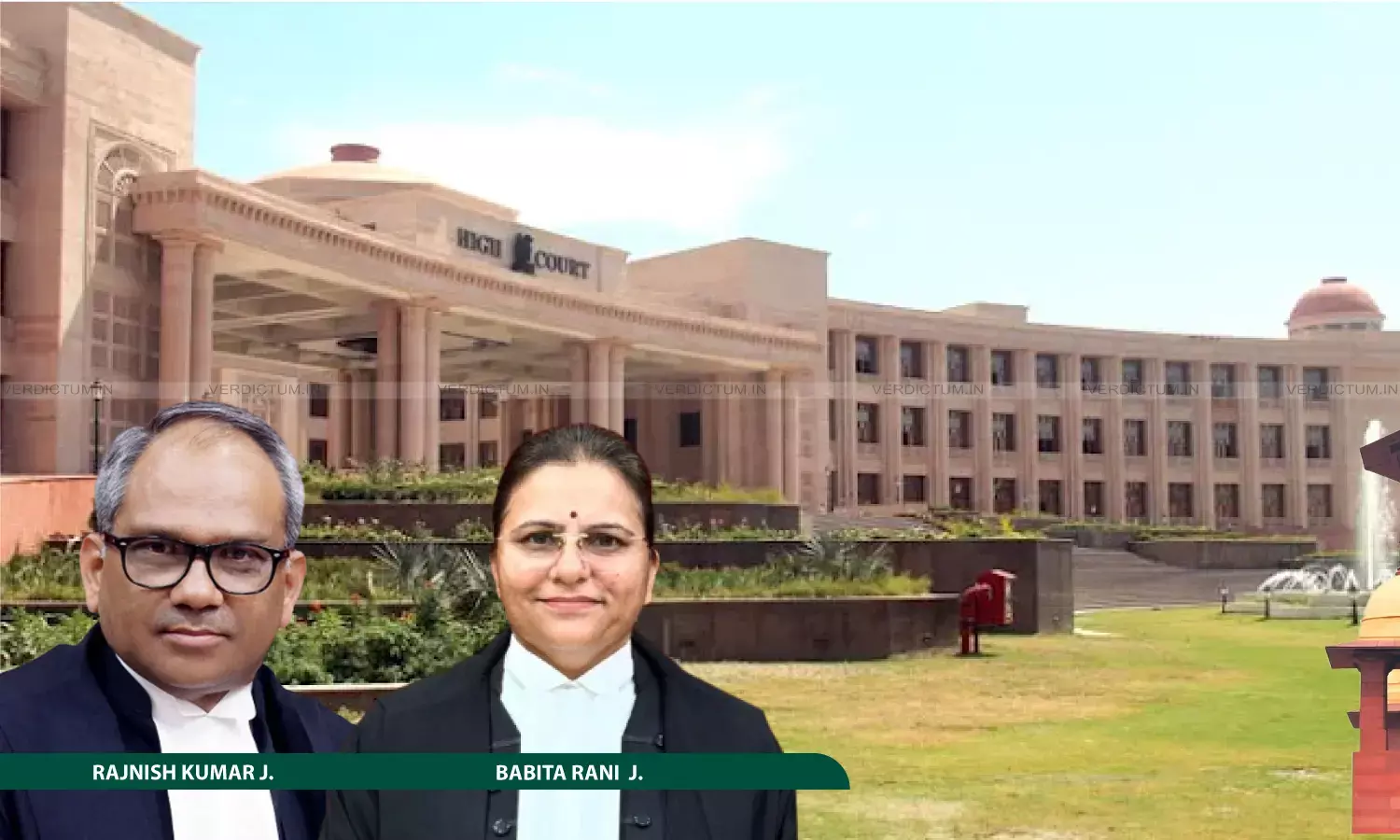
The Allahabad High Court has acquitted a murder convict, holding that "last seen together" evidence alone cannot sustain a conviction without a complete chain of circumstances unerringly pointing towards the guilt of the accused, particularly where the prosecution's star witnesses turned hostile, the sole last-seen witness did not name the surviving appellant, and the motive relied upon by the Trial Court rested on rumour rather than cogent proof.
The Court further held that the forfeiture of a motorcycle used in the alleged commission of crime cannot be sustained where the witness to its recovery was not examined, no reason was recorded for denying return of the vehicle to its owner, and the owner was neither an accused nor a witness, establishing that forfeiture under Section 452 CrPC must meet the evidential standard of proof beyond reasonable doubt and cannot proceed on assumptions alone.
Justice Rajnish Kumar and Justice Babita Rani observed, “…the normal principle is that the circumstances from which an inference of guilt is sought to be drawn must be cogently and firmly established and that those circumstances on the basis of which inference of guilt is drawn, should be of a definite tendency unerringly pointing towards the guilt of the accused only. The circumstances, on the basis of which inference of guilt is sought to be drawn after considering cumulatively, should form a complete chain showing that in all human probability, the crime was committed by the accused only”.
“…However, if the prosecution fails to show and prove the chain of circumstances and exclude every hypothesis other than the guilt of the accused, the conviction on the basis of 'circumstantial evidence' cannot be made and it will not sustain. The conviction can be made on the basis of theory of 'last seen together', where time gap between the pointing of time, when accused and deceased was seen last alive, and, when the deceased is found dead is too short and the probability of other than accused being the author of crime becomes impossible. However, the time gap between both the incident is to be seen on the facts and circumstances of each case and the evidence of last seen together can not be rejected merely because there is long period”, the Bench observed.
Advocate Nagendra Mohan appeared for the appellant and Pawan Kumar Mishra, Government Advocate appeared for the respondent.
As per the facts, on November 02, 1986, the deceased aged approximately 17 years, went missing from Mohalla Dilerganj, Kasba Shahabad, District Hardoi after being seen leaving on a Rajdoot motorcycle with Laxmi Kant alias Pappu, son of Natthu Lal, in whose house, the deceased ran an electrical goods shop.
Rumours of an alleged illicit relationship between Deepak and Laxmi Kant's married sister had been circulating for some weeks, providing the alleged motive. The following morning, an unidentified dead body was found near Jamaur culvert, Shahjahanpur, bearing firearm injuries. The body was subsequently identified by the deceased's father as Deepak Kumar. The motorcycle, a Rajdoot, was recovered from the house of a relative of the appellant Sunil Kumar. The chargesheet was filed against four accused, Laxmi Kant alias Pappu, Sunil Kumar, Sri Kant and Natthu Lal.
A check FIR was initially registered under Section 364 IPC at Police Station Shahabad, District Hardoi on 3 November 1986. After investigation, a chargesheet was filed under Sections 364, 302 and 120-B IPC.
The Sessions Judge, Hardoi, by judgment dated March 04, 1989 acquitted Natthu Lal and Sri Kant but convicted Laxmi Kant alias Pappu and Sunil Kumar under Section 302 read with Section 34 IPC and sentenced each to life imprisonment with a fine of Rs.5,000.
The motorcycle was ordered forfeited to the State. Laxmi Kant alias Pappu and Sunil Kumar filed criminal appeal, while Puttoo Lal Trivedi, owner of the motorcycle, filed another criminal appeal challenging the forfeiture. During the pendency of the appeal, Laxmi Kant alias Pappu died and his appeal stood abated by order dated February 15, 2024. The appeal thus survived only on behalf of Sunil Kumar.
The Court undertook a meticulous re-examination of the prosecution's three-limbed case, last seen together, circumstantial evidence, and motive, and found each to be fatally deficient. The Court found the prosecution's case deficient on every limb. On last seen evidence, PW-1 did not name or identify the surviving appellant Sunil Kumar at all, rendering his testimony irrelevant to Sunil Kumar's conviction.
The Court further noted that Sushil Kumar Singh, the only independent witness who allegedly identified the motorcycle number, was withheld by the prosecution without explanation. The testimony of PW-4, the deceased's aunt, was rejected as highly improbable, the Court observing that persons harbouring common intention to commit murder would not repeatedly pass in front of an acquaintance's house when another route was available. The prosecution's star witnesses PW-5 and PW-6 turned hostile, with PW-6 stating his Section 161 CrPC statement was obtained through fear and police misrepresentation.
The Court held that such statements cannot be used as substantive evidence, and the dying declaration argument consequently failed. On motive, the love letters could not be conclusively attributed to the alleged writer and the Court held that rumour cannot substitute proof of motive. Applying the five Panchsheel principles from Sharad Birdhichand Sarda v. State of Maharashtra and Chetan v. State of Karnataka, the chain of circumstances was found incomplete.
“The evidence of 'last seen together' is very weak kind of evidence and conviction cannot be made only on the basis of evidence of 'last seen together' without considering the 'circumstantial evidence' and chain of circumstances complete in the manner, in which they refer only and only towards the guilt of the accused and there is no hypothesis of innocence of the accused. The 'circumstantial evidence' is to be seen on the touchstone of 5 golden principles (Panchsheel) laid down by the Hon'ble Supreme Court…”, the Bench noted.
On forfeiture, the recovery witness was not examined and the owner was neither accused nor witness, warranting release of the vehicle.
Cause Title: Laxmi Kant @ Pappu (dead) & Anr. v. State of U.P. (Neutral Citation: 2026:AHC-LB:38750-DB)
Appearances:
Appellant: Nagendra Mohan, Virendra Mohan, Rajiv Kumar Bajpai, Suparna Mishra, Advocates.
Respondent: Pawan Kumar Mishra, Government Advocate.