

Material Facts Omitted From Protest Petition Cannot Later Be Introduced Through Oral Statements To Supply Motive: Allahabad High Court
The Court held that once a protest petition is converted into a complaint case, it becomes the foundational pleading and all material facts constituting the accusation must be contained therein.
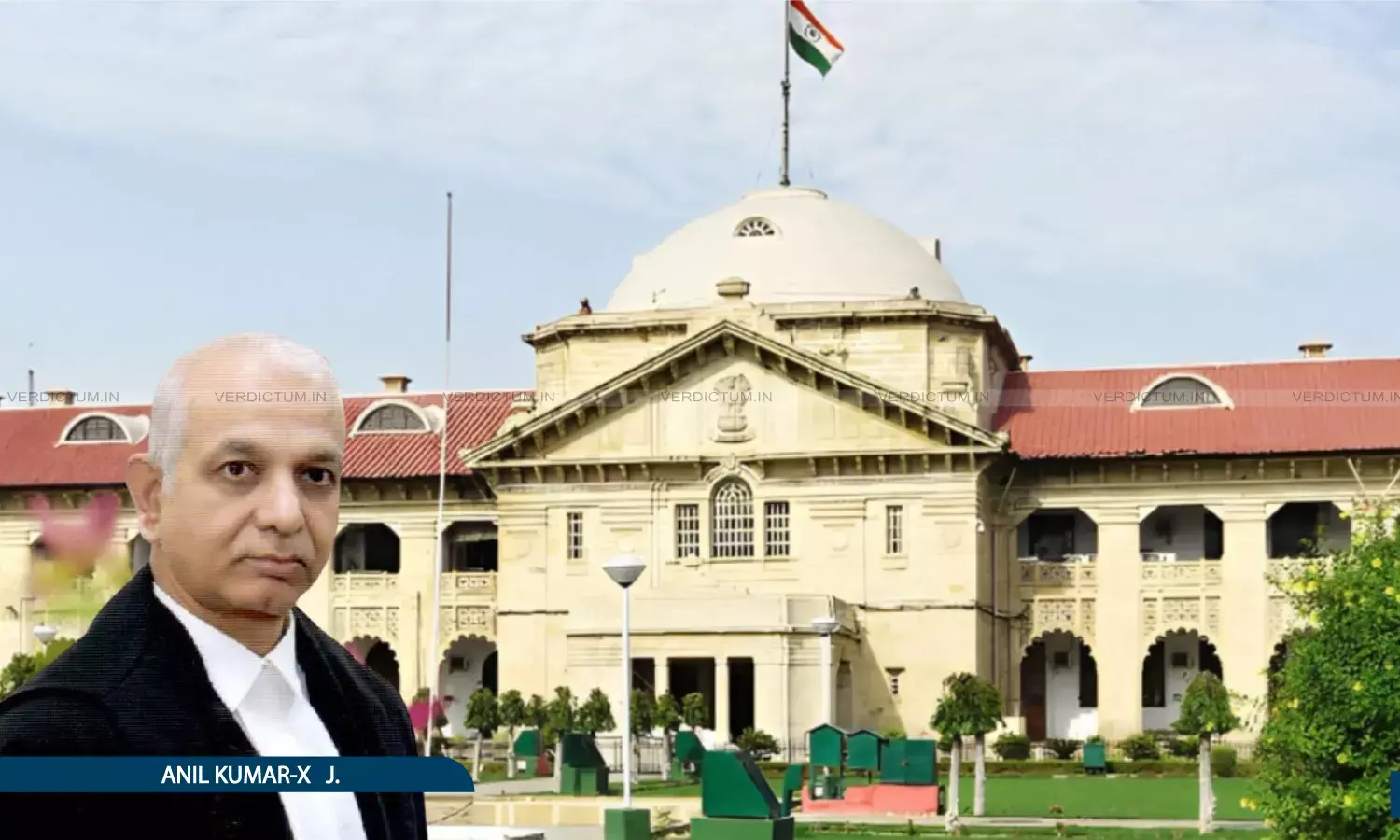
Justice Anil Kumar-X, Allahabad High Court
The Allahabad High Court has held that a protest petition, once converted into a complaint case, becomes the foundational pleading of the complaint proceedings and therefore all material facts constituting the accusation must be specifically pleaded therein.
The Court observed that material omissions in the protest petition cannot ordinarily be cured later through oral statements recorded during enquiry under Sections 200 and 202 Cr.P.C., particularly where such improvements are introduced to establish a motive which was completely absent in the original version.
The Court was hearing a petition under Article 227 of the Constitution challenging orders passed by the revisional court and the Chief Judicial Magistrate summoning the petitioners to face trial under Section 302 IPC after a final report submitted by the police had been converted into a complaint case based on a protest petition.
A Bench of Justice Anil Kumar-X observed: “A protest petition, once converted into a complaint, becomes the foundational pleading of the complaint case and must contain all material facts constituting the accusation. Material facts omitted from the protest petition cannot ordinarily be supplied later through oral statements. Introduction of such facts for the first time during the enquiry amounts to a material improvement and raises serious doubts regarding the genuineness of the accusation. Such improvements assume greater significance when they seek to provide motive where none existed in the original version.”
Advocate Moeez Uddin appeared for the petitioners, while A.G.A. Prateek Tyagi appeared for the respondents.
Background
According to the prosecution's case, information was initially given to the police by the village chowkidar, stating that the deceased had consumed liquor and, in an intoxicated condition, fallen from the roof of a house, resulting in injuries which later caused his death.
Subsequently, the brother of the deceased lodged an FIR under Section 302 IPC alleging that the accused persons had made the deceased consume liquor at their house and thereafter assaulted him, causing fatal injuries.
After investigation, the police submitted a final report concluding that no case was made out against the accused persons. Dissatisfied with the final report, the informant filed a protest petition before the Magistrate, which was treated as a complaint case.
During the enquiry proceedings, statements of seven witnesses were recorded under Sections 200 and 202 Cr.P.C., following which the Magistrate summoned the accused persons to face trial under Section 302 IPC.
Court’s Observations
The High Court noted that neither the FIR nor the protest petition contained any allegation that the deceased had been carrying Rs. 35,000/- at the time he allegedly accompanied the accused persons, nor was there any allegation that the accused had taken him with an intention to grab the said amount.
The Court observed that these facts surfaced for the first time only in the statements recorded during the enquiry under Sections 200 and 202 Cr.P.C. The Court held that such improvements assumed even greater significance because they sought to introduce motive where none existed in the original version.
The High Court observed that the dead body of the deceased had been found lying in front of the house of another person and that neither during the investigation nor during the complaint proceedings had any satisfactory explanation been furnished regarding how the deceased reached that place.
The Court noted that while the complaint version suggested that the deceased had been assaulted and murdered inside the house of the accused persons, no witness explained the circumstances under which the deceased was later found at a different location.
The Court observed: “This missing link goes to the root of the matter and creates a serious gap in the prosecution's story.”
The Court further noted that although the alleged incident had occurred within the village itself and all principal witnesses belonged to the same village, no witness claimed to have direct knowledge of the actual occurrence. The circumstances in which the deceased was found injured and the identity of those who first reached the spot also remained unexplained.
The High Court emphasised that although the law permits a Magistrate to treat a protest petition as a complaint case after submission of a final report, such power must be exercised with “great caution”, especially in cases involving grave offences such as murder.
The Court observed: “The primary object of every criminal proceeding is discovery of truth. If that object cannot effectively be achieved through a complaint enquiry, the Court should consider directing further investigation rather than mechanically converting the final report into a complaint case.”
The Bench further observed that complaint enquiries are not intended to substitute a full-fledged criminal investigation in cases where crucial facts can be established only through scientific, forensic, electronic or circumstantial evidence.
The Court held that Magistrates should not remain “mere spectators” during enquiry proceedings after converting a protest petition into a complaint case.
The Court observed: “Merely recording statements under Sections 200 and 202 Cr.P.C. in a mechanical manner may not always serve the purpose of justice.”
The Bench further held that witnesses should be carefully questioned regarding the source of their knowledge, delay in disclosure, omissions in earlier versions and other circumstances affecting credibility.
The High Court held that the material improvements regarding motive, the absence of such allegations in the FIR and protest petition, the unexplained circumstances concerning the place where the deceased was found and the doubtful testimony of witnesses rendered the summoning order unsustainable.
The Court observed: “The Magistrate failed to properly scrutinise the material placed before it before summoning the petitioners for an offence punishable under Section 302 IPC.”
The Bench accordingly held that the summoning order suffered from non-application of mind and could not be permitted to stand.
Conclusion
The Allahabad High Court held that the complaint version suffered from serious infirmities, including material improvements regarding motive, omission of crucial allegations from the FIR and protest petition, unexplained circumstances concerning the place where the deceased was found and doubtful testimony of witnesses.
The Court further held that the Magistrate had failed to meaningfully scrutinise the material placed on record before summoning the accused persons for an offence punishable under Section 302 IPC, and that the impugned orders reflected non-application of mind.
Accordingly, the Court set aside both the revisional order as well as the summoning order passed in the complaint case.
Cause Title: Lala And Another v. State of U.P. and Another (Neutral Citation: 2026:AHC:124829)
Appearances
Petitioners: Advocates Moeez Uddin and Vikrant Gupta.
Respondents: A.G.A. Prateek Tyagi; Advocate Gaurav Singh Chauhan.
