FSL Expert Report Bereft Of Reasons & Scientific Criteria Of No Avail: Allahabad High Court Issues Suggestions On Forensic Evidence Protocols
The High Court acquitted two murder convicts in a poisoning case after finding that the FSL report did not disclose the tests, data or scientific criteria behind its conclusion, and issued systemic suggestions for improving forensic evidence in criminal trials.
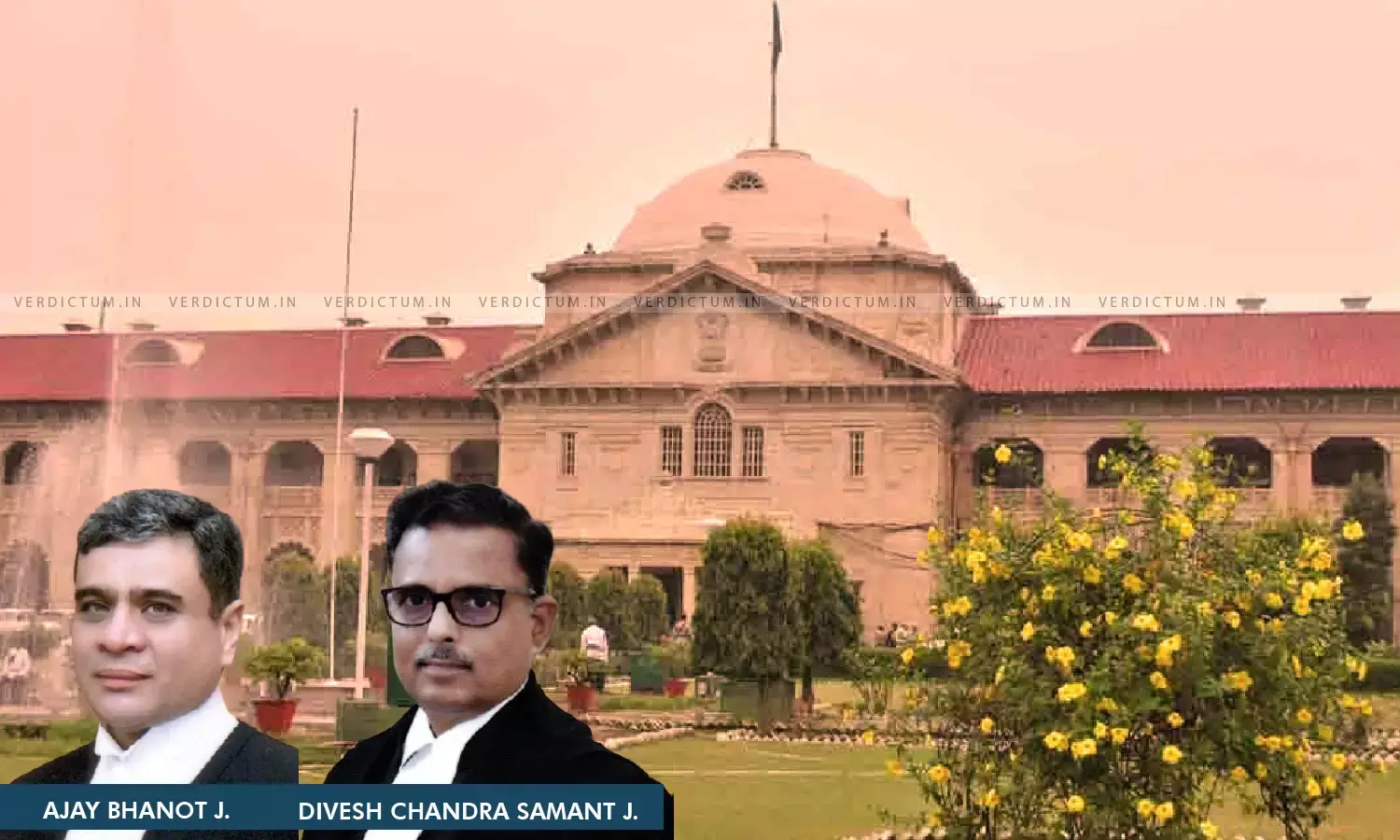
The Allahabad High Court has held that an expert opinion lacking reasons or basic scientific criteria is of no avail, as courts must be able to independently test the correctness of such an opinion by examining the reasons, protocols, materials, and established scientific authorities underlying the conclusion.
The Court was hearing two criminal appeals challenging a conviction under Sections 302/34 and 328/34 IPC in a case where the prosecution alleged that the deceased had been administered poison mixed in food. The Trial Court had sentenced the appellants to life imprisonment for murder and ten years’ rigorous imprisonment for administering poison.
A Bench of Justice Ajay Bhanot and Justice Divesh Chandra Samant observed:
“The opinion of the expert, which is bereft of reasons or does not disclose the basic scientific criteria which has guided the expert to reach the conclusion is of no avail. The purpose of reasons in an expert report is not far to seek. The reasons stated by the expert in support of the conclusions will enable the Court to independently test the correctness of such opinion. For that purpose the Court may also rely on established authorities and protocols in the concerned field and examine the expert report in the perspective offered in such literature. In absence of reasons the Court will not be able to independently come to the conclusion regarding the correctness or otherwise of the experts opinion.”
Advocate Jawahar Lal Maurya appeared for the other appellants, while the Government Advocate appeared for the State.
Background
The prosecution's case was that the deceased was given food mixed with poison, after which he began vomiting and was taken to the hospital. The post-mortem report did not ascertain the cause of death and recorded that the viscera had been preserved. The viscera sample was later sent to the Forensic Science Laboratory, which reported the presence of Aluminium Phosphide.
The Trial Court relied on the prosecution witnesses and the FSL report to convict the appellants. In appeal, the High Court examined whether the FSL report could safely sustain the prosecution's case, particularly when the post-mortem did not independently establish poisoning, and the doctor was not confronted with the forensic findings.
Court’s Observations
The Court first noted that a Government scientific expert’s report may be used in evidence under Section 293 CrPC without examining the expert who authored it. However, it held that the report must still satisfy the standards applicable to expert evidence under Section 45 of the Evidence Act.
The Court explained that the function of expert evidence is advisory and that its value depends on the reasons, data and material furnished in support of the conclusion.
Applying this standard, the Court found that the FSL report merely stated its conclusion without disclosing the scientific process behind it.
The Court observed: “In the case at hand, the expert report submitted by the FSL dated 18.09.2014/Exh Ka-14 simply records the ipse dixit or its conclusion that the Aluminium Phosphide was present in the viscera sample. The report does not disclose any data, tests conducted, scientific criteria or materials which guided the expert to record the aforesaid conclusion.”
It added: “In the absence of such relevant data, the expert report is inadmissible in evidence, and the opinion rendered therein is discarded.”
Since the allegation involved Aluminium Phosphide poisoning, the Court summoned a forensic toxicology expert to assist it. The Court relied on recognised toxicology literature and also referred to Jaipal v. State of Haryana (2003) and Darshan Singh v. State of Punjab (2024), which discussed the nature of Aluminium Phosphide poisoning.
The Court found that the recognised tests for determining the presence of Aluminium Phosphide were not reflected in the FSL report.
The Court noted: “It is evident that the tests for determining the presence of Aluminium Phosphide as cited in the aforesaid authorities are not depicted in the FSL Report/Exh Ka 14. Further, a notable characteristic of the poison as opined in “Essentials of Forensic Medicine & Toxicology” by Dr. KS Narayan Reddy is that death by consumption of Aluminium Phosphide is mostly suicidal. Consumption of Aluminium Phosphide by accident is a remote possibility in view of the pungent nature of the substance.”
The Court also found that the body bore no physical injuries, which affected the prosecution's theory of forcible administration of poison.
The Court held that the prosecution ought to have confronted the doctor who conducted the post-mortem with the FSL report, so that he could indicate whether the symptoms or effects of Aluminium Phosphide poisoning were present and reflected in the post-mortem findings.
The Court observed: “The doctor who had conducted the postmortem was never confronted with the F.S.L. report which opines that the Viscera sample contained Aluminium Phosphide. It was incumbent upon the prosecution to confront PW-4 with the F.S.L. report/Exh Ka-14 and verify whether symptoms or effects of poisoning by Aluminium Phosphide were present in the body or not and whether the same were reflected in the Post Mortem report.”
The Court further stated: “In the facts and circumstances of this case the Viscera report cannot be treated as conclusive evidence of poisoning by aluminium phosphide. The reliability of FSL report depicting poison is strengthened after the doctor who conducted the post mortem is confronted with the same.”
The High Court found that the post-mortem report itself did not ascertain the cause of death, and the doctor also stated that no conclusion on the cause of death could be drawn after the post-mortem. Since the FSL report was discarded and the doctor was never confronted with it, the Court held that poisoning was not established with certainty.
The Court held: “The postmortem report opines that the cause of death could not be ascertained. P.W. 4 in his testimony also stated that no conclusion on the cause of death could be derived after the postmortem. The FSL report has been found to be inadmissible in evidence and has been discarded. P.W. 4 was never confronted with the FSL report. Moreover P.W. 4 under cross-examination has testified that there were symptoms of food poisoning. Prosecution evidence with regard to cause of death lacks certainty and is unreliable. The prosecution has failed to establish the cause of death of the deceased by poisoning.”
The Court also found serious gaps in the chain of preservation of the viscera sample. The sample was preserved at post-mortem, received by the FSL later, and examined more than a year after receipt, but the prosecution did not prove the conditions in which it was kept.
The Court observed: “Furthermore, even the F.S.L. report does not disclose the state of the sample at the time of receipt. The lab conditions in which the sample were kept in the F.S.L. are also absent in the prosecution evidence. This fact assumes significance since the Viscera sample was examined after more than one year after it was receipt. The possibility of degradation of viscera sample during this long gap so as to render it unfit for laboratory testing/evaluation is a real one.”
It added: “The burden is on the prosecution to prove that storage conditions were safe and appropriate for preservation of the viscera sample for future testing. The prosecution has failed to discharge the said burden.”
The High Court held that the Trial Court erred in relying on an inadmissible FSL report and unreliable testimony. It also found that the accused had given credible responses under Section 313 CrPC, including that they had taken the deceased to the hospital and arranged medical attention.
The Court held that the prosecution failed to prove the charges beyond a reasonable doubt and acquitted both appellants.
Conclusion
Allowing the appeals, the Allahabad High Court set aside the conviction, held that the prosecution failed to prove offences under Sections 328/34 and 302/34 IPC beyond a reasonable doubt, and directed the appellants to be released forthwith unless required in any other criminal case. The Court also directed that a Hindi translation of the judgment be served upon the appellant through the District Legal Services Authority.
Furthermore, while taking note that “the conduct of investigations and prosecution in the instant case has exposed some of the faultlines in the criminal justice system”, the Court then made the following suggestions:
I. Conclusions in the FSL report expert report have to be supported with specific reasons. The reasons include the scientific criteria adopted, laboratory tests, and other material and scientific protocols followed in testing the sample and which form the basis of the conclusions in the FSL/ Expert Report.
II. The credentials/qualifications and experience of the expert who has authored the FSL Report/ expert report will be disclosed in the FSL/expert report.
III. The details of safe preservation of the samples (in the instant case, it was the viscera report) and the fitness of sample for testing shall also be recorded in the expert report.
IV. Strict SOPs for receipt and transfer of samples to be attested by the laboratories/ experts shall be laid down and revealed in the prosecution evidence. The aforesaid procedures shall contain appropriate safeguards against tampering or degradation of the samples.
V. The doctors who have conducted the post mortems shall also be confronted with the findings of the FSL.
VI. The competent authorities including Director General of Police, Directors of Forensic Science Laboratory shall ensure proper training of officials and experts for implementation of the above said safeguards in order to uphold the law and prevent the miscarriage of justice.”
Cause Title: Gyanmati @ Sangathiya v. State of U.P. with Ashok Kumar @ Putti Lal v. State of U.P. (Neutral Citation: 2026:AHC:146616-DB)
Appearances
Appellants: Advocates Jawahar Lal Maurya, Mary Puncha (Sheeba Jose), Mohd. Kalim, Ram Naresh Singh, Ramesh Chandra Yadav, Anupam Maurya, Purushottam Pandey, Vindo Kumar Kushwaha and Vinod Kumar Kushwaha
Respondent: G.A.