Named Co-Adulterer Must Be Heard Before Adverse Finding In Maintenance Case: Allahabad High Court
The Court also held that Section 14 of the Family Courts Act permits a Family Court to receive electronic material but does not automatically establish its authenticity, reliability or evidentiary value.
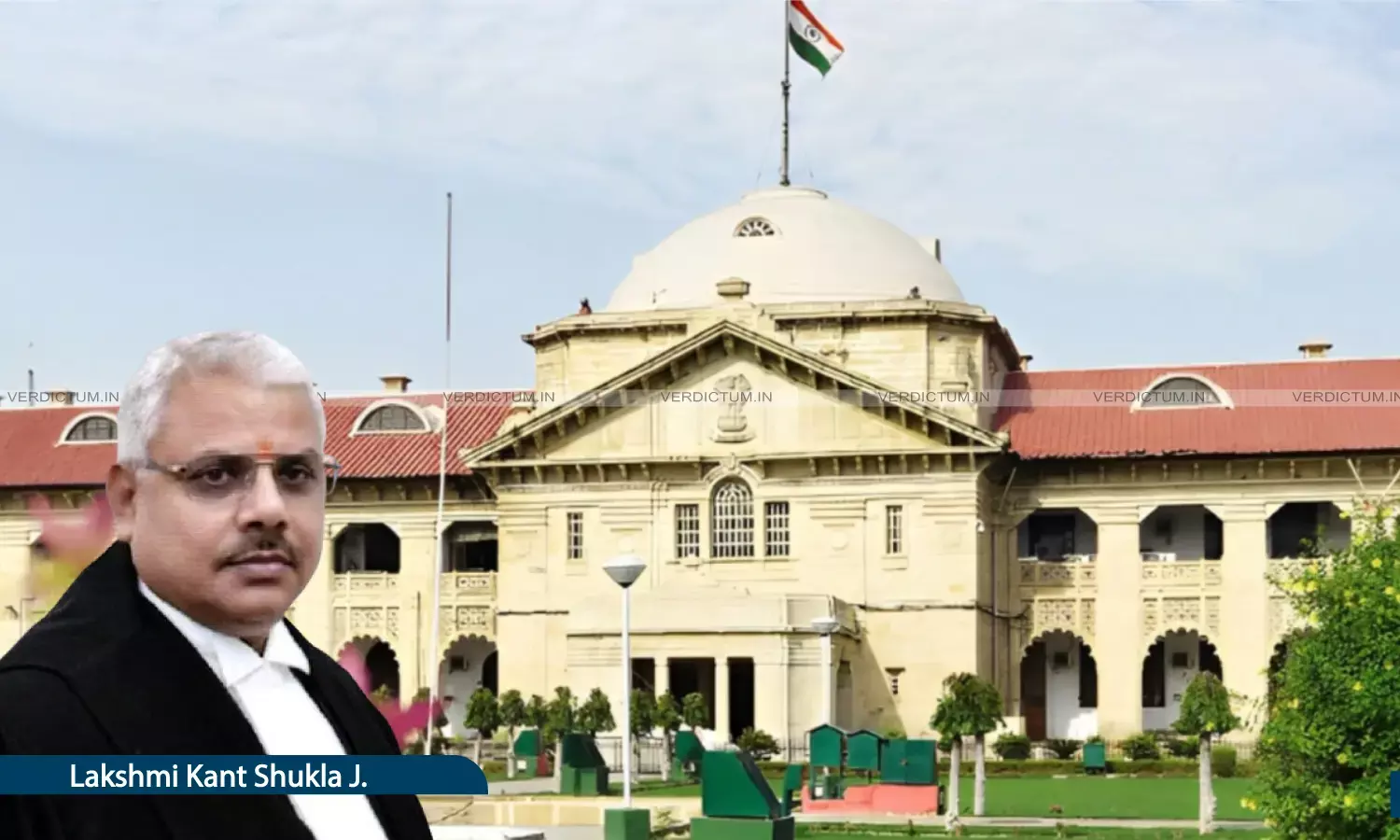
Justice Lakshmi Kant Shukla, Allahabad High Court
The Allahabad High Court has held that a specifically identified person accused of having an adulterous relationship must be afforded an opportunity of hearing before an adverse judicial finding is recorded against that person in maintenance proceedings under Section 125 CrPC.
Noting that Section 125 does not prescribe how such a person should be impleaded or issued notice, the Court directed the Registrar General to place the matter before the Chief Justice for consideration of appropriate procedural rules. It also dismissed the husband’s revision and affirmed the maintenance awarded to his wife and minor son.
The Court was hearing a criminal revision challenging a Family Court order directing the revisionist to pay monthly maintenance of ₹20,000 to his wife and ₹10,000 to their minor son from the date of the maintenance application.
A Bench of Justice Lakshmi Kant Shukla observed: “While the principle of audi alteram partem requires that a specifically identified person, against whom an allegation of adultery is made and against whom an adverse finding is proposed to be recorded, ought to be afforded an opportunity of hearing, the provisions of Section 125 Cr.P.C. does not contain any specific procedural provision prescribing the manner in which such person is to be impleaded or notice is to be issued to him. On the other hand, Rule 6(a) of the Hindu Marriage and Divorce Rules, 1956, framed by this Court, specifically provides for impleadment of the alleged adulterer or adulteress as a co-respondent in proceedings for divorce or judicial separation on the ground of adultery, subject to the exceptions contained therein. The aforesaid procedural gap, therefore, merits consideration at the appropriate level so that the Family Courts are not left without a defined procedure while dealing with a specific allegation of adultery in proceedings under Section 125 Cr.P.C.”
Advocate Kalyan Sundram Srivastava appeared for the revisionist. Advocate Santosh Kumar Singh appeared for the wife and minor son, while an Additional Government Advocate appeared for the State.
Background
The Family Court granted maintenance to the revisionist’s wife and minor son. Challenging that order, the revisionist alleged that his wife was living in adultery with a specifically named person and argued that Section 125(4) CrPC disentitled her from receiving maintenance.
The revisionist relied on photographs and other electronic material. He contended that the Family Court had wrongly declined to consider the material because it was not accompanied by a certificate under Section 65-B of the Indian Evidence Act. He also sought to introduce additional evidence during the revision.
The wife and minor son opposed the revision. Their counsel submitted that the photographs had not been duly proved, that some appeared to be identical or composite images and that the material did not establish an adulterous relationship.
Court’s Observations
Section 14 Does Not Make Electronic Material Self-Proving
The Court held that Section 14 of the Family Courts Act gives Family Courts flexibility to receive material that may assist in deciding a dispute, even where it may otherwise be inadmissible under the Indian Evidence Act. It clarified that receiving such material does not establish its authenticity or evidentiary value.
The Court observed: “Section 14 of the Family Courts Act, 1984, empowers a Family Court to receive any report, statement, document, information or other matter which, in its opinion, may assist it in effectively dealing with a dispute, irrespective of whether the same would otherwise be relevant or admissible under the Indian Evidence Act, 1872. The provision, therefore, confers upon the Family Court a degree of flexibility in receiving material for the effective adjudication of disputes before it. However, the power to receive material cannot be treated as a declaration that every document or electronic record so received is authentic, reliable or sufficient to establish the fact sought to be proved through it.”
Referring to Himanshu Chordia v. State of Rajasthan (2026), Praveen Kumar Singh v. State of U.P. (2026) and Lumeshwari alias Pinky v. Rajesh Dubey (2025), the Court stated that the power to receive electronic material does not dispense with judicial scrutiny of its source, accuracy and reliability.
The Court found that the source, manner of creation and authenticity of the photographs had not been established. No witness had been identified as having taken or recorded them or as being capable of verifying that they were original and unaltered. The Bench consequently held that the material could not be treated as conclusive proof of adultery.
Summary Maintenance Proceedings Must Follow Natural Justice
Referring to Chaturbhuj v. Sita Bai (2008) and Rajnesh v. Neha (2021), the Court stated that Section 125 CrPC is a social-justice measure providing a speedy remedy against destitution and vagrancy. It added that Section 125(4) nevertheless requires a court to examine a specifically pleaded allegation that a wife is “living in adultery”.
The Court held that the summary nature of the proceedings does not permit an adverse finding against an identifiable person without an opportunity of hearing.
The Court observed: “The summary nature of a proceeding does not exclude the application of the fundamental principles of natural justice. The rule of audi alteram partem embodies the elementary requirement that a person should not be adversely affected or condemned without being afforded a reasonable opportunity of meeting the case against him.”
Referring to decisions concerning the need to hear a named alleged co-adulterer, the Court added: “The Karnataka High Court in Arun Kumar Agrawal v. Radha Arun and anr., while considering the question in matrimonial proceedings, recognised the adverse impact which such a finding may have upon the reputation of the alleged adulterer and the necessity of affording him an opportunity to defend himself. The same principle was subsequently followed in Bhaktvatsal Singh Rajput v. Vandana Rajput, wherein the alleged adulterer was held to be at least a proper party for effective adjudication of the issue of adultery.”
Right To Reputation Protected Under Article 21
Relying on Subramanian Swamy v. Union of India (2016), the Court stated that reputation is an integral facet of the right to life and personal liberty under Article 21. It held that a finding attributing an adulterous relationship to an identifiable person may affect that person’s character, reputation and dignity beyond the maintenance dispute.
The Court added that although the Code of Civil Procedure does not strictly govern Section 125 proceedings, the principle underlying Order I Rule 10(2) CPC provided useful guidance. It clarified that the question was not whether every alleged co-adulterer must invariably be impleaded, but whether an adverse finding could be returned against a specifically identified third person without allowing that person to answer the allegation.
Rule 6(a) Reflects The Same Principle Of Fairness
The Court noted that Rule 6(a) of the Hindu Marriage and Divorce Rules, 1956, framed by the Allahabad High Court, requires an alleged adulterer or adulteress to be made a co-respondent in divorce or judicial-separation proceedings founded on adultery, subject to specified exceptions.
The Court also considered Rule 12 of the Delhi High Court Hindu Marriage Rules, 1979, and Rules 16, 17 and 18 of the Hindu Marriage Rules framed under the Patna High Court Rules. It held that Shivi Bansal v. Gaurav Bansal (2024) and Radhika Devi v. Abhishekh Kumar Gupta (2025) could not be applied because the findings in those cases were contrary to the relevant procedural rules.
Explaining why the same underlying principle was relevant to maintenance proceedings, the Court stated: “It is true that proceedings under the Hindu Marriage Act and proceedings under Section 125 Cr.P.C. operate in different statutory fields but if the law, in the context of matrimonial adjudication between spouses, has considered it necessary to protect the reputation of an alleged adulterer by requiring his impleadment and opportunity of hearing under Rule 6(a), the same underlying principle of fairness, natural justice and protection of reputation cannot be regarded as wholly irrelevant when the very same allegation of adultery is sought to be adjudicated in proceedings under Section 125 Cr.P.C.
The Bench added: “A judicial finding attributing an adulterous relationship to a specifically identified person cannot be regarded as an inconsequential observation. Such a finding may have consequences extending beyond the determination of the maintenance claim and may cause prejudice to the reputation and dignity of the person concerned. The fact that the finding is recorded in a summary maintenance proceeding does not alter the nature of the prejudice which may be caused to the person against whom such finding is recorded.”
Relying on Udai Narain Bajpai v. Kusum Bajpai (1975), the Court added that recording a finding capable of damaging a named person’s character and reputation without allowing that person to defend himself would violate natural justice.
Procedural Gap In Section 125 CrPC
The Court stated that Rule 6(a) directly governs divorce and judicial-separation proceedings, while Section 125 CrPC contains no procedure for impleading or issuing notice to a specifically named alleged co-adulterer.
The Bench consequently remarked: “… the Registrar General of this Court is directed to place this matter before Hon’ble the Chief Justice for appropriate consideration and directions and for taking necessary steps either to frame appropriate rules prescribing the procedure for impleadment or issuance of notice to a specifically named alleged co-adulterer in proceedings under Section 125 Cr.P.C., or for extending the principle contained in Rule 6(a) of the Hindu Marriage and Divorce Rules, 1956, with such necessary modifications as may be considered appropriate, to proceedings under Section 125 Cr.P.C”.
No Automatic Right To Introduce Additional Evidence At Revisional Stage
The Court held that the power to receive additional evidence under Sections 391 and 401 CrPC is discretionary and does not confer an unrestricted right to introduce new material during revision.
Referring to Bhagwan Swaroop v. State of U.P. (2014), the Court stated: “In the present case, the revisionist seeks to rely upon photographs and electronic material in support of the allegation of adultery. As discussed above, the material has not been satisfactorily authenticated, and no supporting witness has been identified to establish its source or genuineness. Further, the alleged co-adulterer, whose identity has been specifically disclosed, has not been afforded an opportunity to respond to the allegation. In these circumstances, the material sought to be introduced at the revisional stage does not establish a sufficient basis for exercising the discretionary power to receive additional evidence. The request for taking such material on record is, therefore, declined.”
No Ground To Interfere With Maintenance
The Court held that the revisionist had not established any error warranting interference with the Family Court’s assessment of his income, the maintenance amount or the wife’s reasons for living separately.
The Court observed: “The grounds raised by the revisionist, including the allegation regarding adultery, do not furnish any legally sustainable basis for setting aside the impugned order granting maintenance. The revisional jurisdiction of this Court cannot be invoked merely because another view of the material on record may be possible. Interference is warranted only where the impugned order suffers from an error calling for exercise of revisional jurisdiction. No such ground has been made out in the present case.”
Conclusion
The Court dismissed the criminal revision and affirmed the Family Court’s direction requiring the revisionist to pay monthly maintenance of ₹20,000 to his wife and ₹10,000 to their minor son from the date of the maintenance application.
It further directed the Registrar General to place the matter before the Chief Justice for considering rules governing the impleadment or issuance of notice to a specifically named alleged co-adulterer in Section 125 CrPC proceedings, or extending the principle contained in Rule 6(a) of the Hindu Marriage and Divorce Rules, 1956, with appropriate modifications.
Cause Title: GS v. State of U.P. and 2 Others (Neutral Citation: 2026:AHC:214569)
Appearances
Revisionist: Advocates Kalyan Sundram Srivastava and Raghunandan Singh
Opposite Parties: Government Advocate for the State; Advocate Santosh Kumar Singh for opposite party nos. 2 and 3