

Secondary Evidence Such As Unverified Photocopies No Basis To Institute Criminal Proceedings For Cheating & Forgery: Allahabad High Court
The Allahabad High Court was considering three applications filed under Section 528 of the BNSS and Section 482 of the Cr.P.C. seeking quashing of the criminal proceedings.

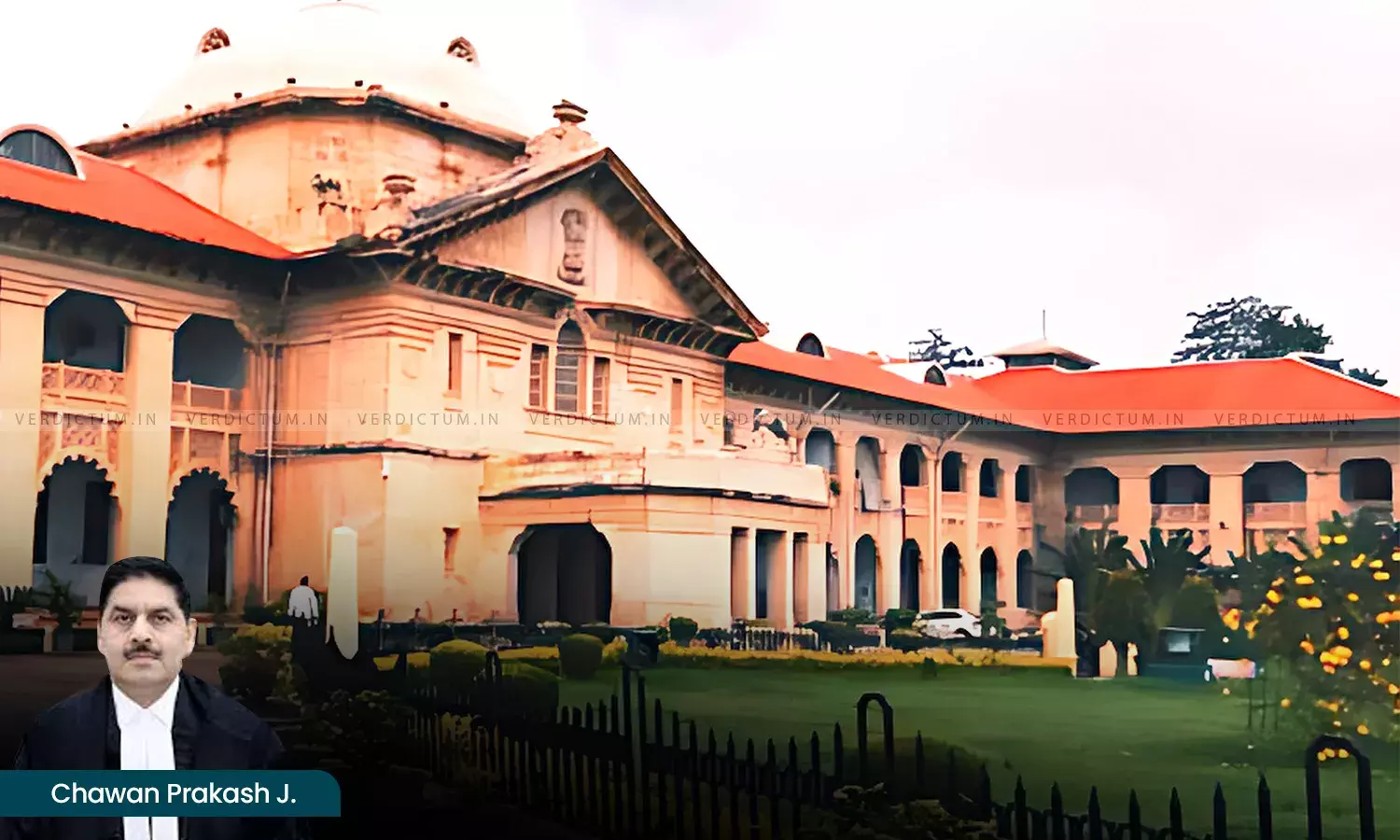
Justice Chawan Prakash, Allahabad High Court
The Allahabad High Court has reiterated that secondary evidence, such as unverified photocopies without any primary report providing forensic or expert validation, cannot form the sole basis for instituting criminal proceedings for serious offences such as those of forgery and forgery for the purpose of cheating under Sections 467 and 468 of the IPC.
The High Court was considering three applications filed under Section 528 of the BNSS and Section 482 of the Cr.P.C. seeking quashing of the criminal proceedings.
The Single Bench of Justice Chawan Prakash held, “To establish the offences of forgery and using forged documents as genuine, it is imperative to establish that a forged document was created within the meaning of Section 464 of the IPC. It is a settled principle of law that secondary evidence, such as unverified photocopies without any primary report providing forensic or expert validation, cannot form the sole basis for instituting criminal proceedings for serious offences such as those under Sections 467 and 468 of the IPC. In a prosecution for forgery, the prosecution must show that a false document was created with the intent to cause damage or injury.”
Senior Advocate Kunal Shah represented the Applicants, while Advocate Alok Ranjan Mishra represented the Respondent.
Factual Background
The dispute arose from a complaint and a First Information Report lodged by the second opposite party under Sections 420, 467, 468 and 471 of the IPC, read with Section 447 of the Companies Act. In the complaint, he stated that he is a member, shareholder, promoter and director of M/s. M.T.G. Infra Power Ltd. and a commercial director of M/s. S.P.B.L. Energies Pvt. Ltd. The applicants were directors of S.P.B.L. Energies Pvt. Ltd. and managed its day-to-day affairs. Under the agreement, all government tenders obtained by M/s. S.P.B.L. Energies Pvt. Ltd. were to be subcontracted to M/s. M.T.G. Infra Power Ltd., and all payments pertaining to such contracts were to be deposited in a jointly operated bank account for which the complainant was to be a mandate holder.
It was alleged that the applicants subsequently diverted tender-related funds into unauthorised bank accounts that were neither jointly operated nor accessible to the informant. It was alleged that the accused fabricated invoices and delivery challans in the names of fictitious suppliers to simulate the procurement of materials for the S.P.B.L. contracts. On the strength of these fabricated documents, payments totalling approximately Rs. 50 crores were allegedly made from the company's funds to fictitious suppliers. When confronted, two of the applicants, namely Somendra Mehta and Gourang Garg, admitted their misconduct.
The Additional Sessions Judge summoned the applicants. During the pendency of the above-mentioned complaint case, the complainant lodged a First Information Report against the applicants, namely, Somendra Mehta, Romendra Mehta, Sandeep Garg and Gaurang Garg. The FIR contained substantially the same allegations, with the additional allegation that the applicants, as directors of M/s S.B.B.L. Energies Private Limited, had forged seven bank guarantees and submitted them to secure the award of work contracts worth crores of rupees. The E.O.W. formally commenced the investigation and the Investigating Officer filed a final report concluding that no case was made out against the applicants. The complainant filed a protest petition, and the applicants were summoned. Aggrieved by the dismissal of their applications for discharge, the applicants approached the High Court.
Reasoning
The Bench rejected the primary objection raised by the complainant that an application under Section 528 of the BNSS is automatically non-maintainable due to the availability of a criminal revision under Section 438 of the BNSS. Reference was made to the judgment in Dhariwal Tobacco Products Ltd. v. State of Maharashtra, (2009) and Prabhu Chawla v. State of Rajasthan, (2016) where the Apex Court has observed that the availability of a revisional remedy under Section 438 of the BNSS does not create an absolute bar against invoking inherent jurisdiction under Section 528.
On a perusal of the e-mentioned statements by the bank officials, the Bench held that the photocopies of the alleged forged bank guarantees could not be verified because the originals were not available. The Bench noted that these witnesses did not authenticate that the bank guarantees were forged.
“Sections 420 IPC is not stand-alone offences. It is in consequences of cheating as defined in Section 415 IPC. Section 420 deals with cheating coupled with dishonest inducement leading to the delivery of property or interference with a valuable security. The statutory sequencing is explicit: Section 420 begins with the words, "whoever cheats and thereby dishonestly induces..." Unless the ingredients of Section 415 are first disclosed, Section 420 can be pressed into service”, it added.
The Bench also took note of the fact that the Apex Court has repeatedly stated that Section 420 necessarily postulates cheating under Section 415, with dishonest inducement resulting in the delivery of property or interference with a valuable security, as contemplated in the statute. The Bench also noticed that the only allegations against the applicants were that they used 7 forged bank guarantees to obtain tenders, whereas the bank officials had not verified those bank guarantees as forged bank guarantees.
The Bench further held that the original bank guarantees were never recovered or submitted. The issuing bank confirmed that no internal record established that the documents were forged, and DVVNL did not register any grievance concerning fraud or misrepresentation in the tender process. “Neither the electricity department nor the bank reported any fraud, breach, loss, or misrepresentation. A co-director of a company cannot arbitrarily allege that "the company defrauded third parties" when those third parties themselves explicitly deny any such fraud or illegality”, it stated while also adding, “The five-year delay in lodging the First Information Report (the alleged tender fraud of 2013 having been reported in 2018), combined with the ongoing business partnership dispute between Opposite Party No. 2 and the applicants, strongly militates against allowing criminal prosecution to be weaponised to settle private commercial grievances.”
Thus, allowing the petition, the Bench quashed the summoning orders.
Cause Title: Gaurang Garg & Ors. State of U.P. and Another (Neutral Citation: 2026:AHC:229628)
Appearance
Applicants: Senior Advocates Kunal Shah, Saumitra Dwivedi
Respondents: Advocates Alok Ranjan Mishra, Amrita Rai Mishra, Government Advocate
Click here to read/download Order