

"Bulldozer Justice" Cases: Allahabad High Court Delivers Split Verdict On Two-Year Demolition Shield After FIR And One-Year Notice Before Municipal Action
The High Court delivered separate opinions on preventive constitutional protection against alleged “bulldozer” action, with Justice Atul Sreedharan treating retaliatory demolition as a colourable exercise of executive discretion and Justice Siddharth Nandan declining to endorse fixed timelines created in the exercise of writ jurisdiction.
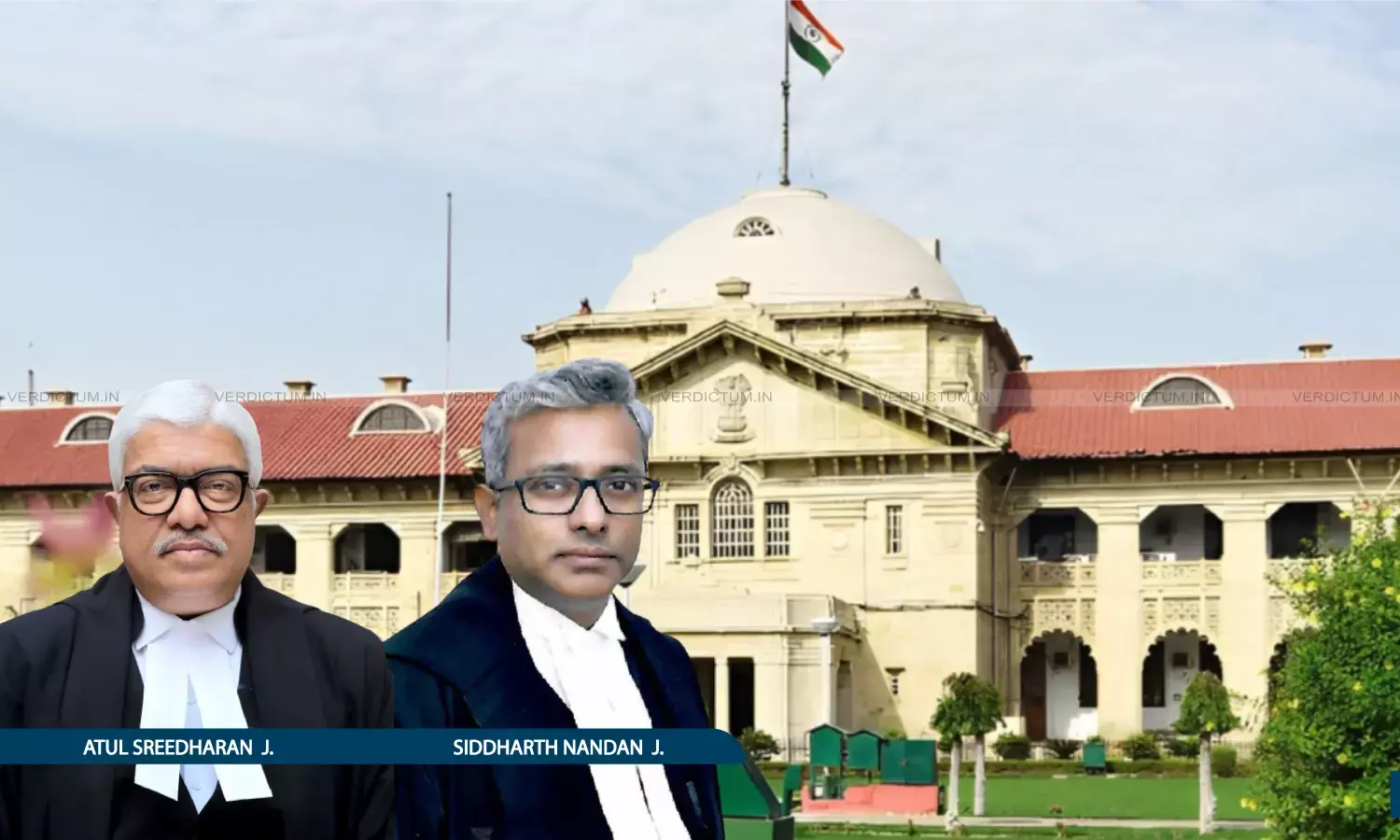
The Allahabad High Court has delivered split opinions on the extent to which writ jurisdiction can be used to restrain alleged “Bulldozer Justice”, with one judge holding that a dwelling house should not be demolished for two years after registration of an FIR where the action bears a retributive character, while the other declined to agree with a general two-year demolition shield and a mandatory one-year notice before municipal action.
The Court was hearing a writ petition in which the petitioners alleged that, after a criminal case was registered against a family member and later against one of them, their residence and business premises were targeted for coercive action. The State opposed the plea as premature and submitted that no demolition would be carried out except in accordance with law.
A Bench of Justice Atul Sreedharan and Justice Siddharth Nandan delivered separate opinions.
Justice Sreedharan, in the Judgment authored by him, observed:
“The Constitution also stands by the rights of the ‘little man’ of this country who may have no prominence in society on account of his minimal financial status and not being a person of means. In removing dwelling places found non-compliant with the municipal laws, the Benthamite utilitarian approach of summarily evicting the few for the larger good of the many, would be a square peg in a round hole in the Indian context. The Constitution is an inorganic being with its life infused by the aspirations of the people it serves. Such aspirations change with time which the constitution accommodates without doing violence to its basic structure. So the question is in what manner should this Gordian knot of balancing equities of the State on one hand and that of the individual be managed?”
Justice Nandan, while agreeing with some directions, authored a separate judgment, stating:
“As far as the implications with respect to the non-compliance of the judgment of the Supreme Court in In Re: Directions in the Matter of Demolition of Structures (supra), is concerned the same has been dealt by my brother Hon’ble Atul Sreedharan, J., and the same has also been adopted in the directions contained in Para-73 and 74, to which I respectfully agree with; but however, as far as the directions contained in para-75, 76, 77 and 80 is concerned, I am unable to concur with the said directions, in my humble opinion. As far as the additional directions contained in paras-78, 79 and 81, the same has been mutually incorporated and as such I am in respectful agreement to the said directions as well.”
Advocate Shamsuddin Khan appeared for the petitioners, while the Chief Standing Counsel appeared for the State authorities.
Background
The petitioners approached the High Court alleging an imminent threat of demolition and coercive administrative action against their residence, lodge and saw mill. Their case was that the proposed action was not ordinary enforcement of municipal law, but a retaliatory response following criminal proceedings.
The State disputed this and submitted that the petition was premature. It also referred to separate statutory proceedings concerning the saw mill, while assuring the Court that action against the residence and lodge would not be taken without following the procedure established by law.
Against this backdrop, the Bench examined the Supreme Court’s decision in In Re: Directions in the Matter of Demolition of Structures (2025), the supplementary directions in Rajendra Kumar Barjatya v. U.P. Avas Evam Vikas Parishad (2024), and the constitutional principles governing shelter, livelihood, equality, due process and executive accountability.
Court’s Observations
Per Justice Atul Sreedharan
Justice Sreedharan began by treating a house as more than an item of property. He said demolition of a dwelling place affects dignity, family stability, security, livelihood and the ordinary rhythm of life.
The Court observed: “A man can absorb the uncertainties of life and bounce back if he has a shelter over his head. Take that away abruptly without giving him adequate time to re-settle himself elsewhere, and you may have consigned, not just him, to the deepest abyss of despair, but all those dependent on him, whose normal rhythm of life was dictated by a sense of security of not having to bother about a safe shelter.”
Justice Sreedharan noted that the Supreme Court’s “bulldozer case” was intended to end the demolition of houses as a punitive response to criminal allegations. However, he observed that the practice continued under the language of removing “land mafia” and “illegal encroachments”.
The Court stated: “This action by the State is largely to satiate the perceived blood lust of a society fed on a staple diet of bulldozer justice over the electronic media, social media and messaging platforms, on account of which the State of Uttar Pradesh (and now several others), has found it convenient to raze the dwelling place of citizens in the name of irradicating ‘land mafia’ and removing ‘illegal encroachments’, a phrase substituting the word ‘criminals’ after the Supreme Court judgement against demolition of dwelling places of persons accused of crime.”
He further noted that demolition often occurs before an affected person can meaningfully approach court: “However, the judgment of the Supreme Court notwithstanding, the demolition of structures continue at will, with the State running through the mandatory directions of the Supreme Court in the case abovementioned within a couple of months and then demolishing the structure even before the affected citizen has a fighting chance to approach the courts for succour.”
Justice Sreedharan framed the case around whether a citizen may invoke Article 226 on a reasonable apprehension of demolition, instead of waiting until the house has already been razed.
The Court noted: “This Court is a witness to several cases where the notice for demolition is issued to persons occupying a dwelling place, hard on the heels upon registration of an FIR and thereafter demolished after the ostensible fulfilment of statutory requirements. These demolitions have continued unabated, notwithstanding the law laid down by the Supreme Court in Re: Directions in the Matter of Demolition of Structures (Writ C No. 295 of 2022 – (2025) 5 SCC 1) that punitive demolition of structures is violative of the separation of powers, as the authority to punish for an offence, vests exclusively with the judiciary.”
Relying on Olga Tellis v. Bombay Municipal Corporation (1985), Chameli Singh v. State of U.P. (1996), Shiv Sagar Tiwari v. Union of India (1997), Mansi Brar Fernandes v. Shubha Sharma (2026), and Zulfiquar Haider v. State of Uttar Pradesh (2025), Justice Sreedharan held that shelter cannot be severed from the constitutional guarantee of life.
Justice Sreedharan observed: “Thus, the discussion on the judgements hereinabove, is merely an elucidation of the law laid down over decades of judicial pronouncements that the right to life, include the right to livelihood and the right to shelter without which, the right to life itself would be rendered meaningless and animalistic. However, these judgements of the Supreme Court notwithstanding, the demolitions continue with impunity as though these judgments do not exist, or the State is certain that the defiance towards the law laid down by the highest Court of the land shall not visit them with any adverse consequences.”
Justice Sreedharan formulated what he called “Retributive Exercise of Executive Discretion” as a species of colourable exercise of executive discretion. In his view, a formally lawful municipal power becomes unlawful when used for a punitive purpose.
Justice Sreedharan held: “Colourable Exercise of Executive Discretion can render an otherwise lawful act, unlawful. Simply stated, it means that where the entrusted power or authority is exercised for a reason other than which the power was intended, and the resultant effect is adverse upon another, that action, though otherwise legitimate under the law, is rendered unlawful on account of malice in law.”
The Judge stated: “The continuation of the bulldozer actions by the State as is attempted in the case of the Petitioners herein, has compelled this Court to carve out a Specie of Retributive Exercise of Executive Discretion as the Vilest Specie of the Genus Colourable Exercise of Executive Discretion. In bulldozing the house of a person accused of an offence, the State is not acting with the avowed aims of enforcing the Statement of Objects and Reasons of the municipal laws but to punish the accused and his entire family staying in that house, while projecting the action as one of removing an illegal construction.”
Justice Sreedharan held that if the State targets only one house after registration of an FIR while ignoring similarly placed structures nearby, the action may disclose mala fides.
The Court observed: “Thus, the devil is in the details. If the intention of the State is to remove illegal construction, it cannot be restricted only to a single house but to all those houses which are in the vicinity and are also violative of the municipal or panchayat laws. Selectively demolishing a house belonging to an accused immediately after the registration of the FIR, is downright malicious.”
At the same time, Justice Sreedharan clarified that illegal constructions do not acquire legitimacy merely by long occupation. His concern was with abrupt displacement, selective enforcement and State complicity in permitting such structures to exist.
The Court noted: “By no stretch of imagination can protection be accorded to such construction and they must be removed if the need occurred and the Supreme Court is right when it holds that prolonged stay does not perfect a right. But the question is whether it would be just and proper to bear in mind the right to shelter of the person living in such a dwelling place, only for the limited purpose of giving him reasonable and sufficient time to resettle himself and his family elsewhere, rather than be forced on to the pavement in the dead of night or go to a night shelter.”
On the role of officials, the Court added: “No dwelling place comes up overnight. The authorities who have the duty to ensure that such structures do not come up, close their eyes deliberately on account of political or bureaucratic support that the builder has or out of dishonesty.”
Per Justice Siddharth Nandan
Justice Nandan agreed that the Supreme Court’s directions in In Re: Directions in the Matter of Demolition of Structures (2025) and Rajendra Kumar Barjatya (2024) must be followed. He also agreed that selective retaliatory action and officer accountability are serious constitutional concerns.
However, he disagreed with issuing directions in rem restraining demolition of an accused’s house for two years from the registration of an FIR.
The Court observed: “I am unable to subscribe to an embargo being put on the demolition of the house ‘for a period of 2 years’ from the date of registration of the FIR; and though I am conscious of the fact that during the hiatus of 2 years, in certain contingencies, for example in case there is imminent public urgency to reclaim State land and if the action is not restricted to the house of the accused alone, my esteemed brother had carved out an exception and made it permissible, subject to the compliance with directions given by the Supreme Court in the Buldozar’s case; but in my humble opinion no fixed time period can be put, for as a matter of fact, it would result in keeping the operation of an enactment in abeyance, for the said period.”
Justice Nandan also declined to agree with a mandatory one-year “notice of intent” before initiating municipal proceedings.
The Judge stated: “There is no provision in the Act to give a ‘notice of intent’ to initiate proceedings prior to ‘1 year’ of actual initiation of such a procedure; whereas what is provided is a notice for violations; and the procedure prescribed, appears to be in adherence to the principles of natural justice as well; and as such in my humble opinion a ‘1 year notice’ to show the intent, for initiating the process, also cannot be given.”
He held that Article 226 must be exercised with restraint and cannot be used to create timelines absent from the statute.
The Court underscored: “In my humble opinion, the functions of the Courts and the exercise of powers under Article 226 of the Constitution of India, is not unbridled power; and is to be exercised by self restraint; and only in extra-ordinary circumstances, such a discretion has to be exercised.”
Since the judges disagreed on the two-year demolition shield and the one-year prior notice requirement, Justice Nandan directed that the matter be placed before the Chief Justice for nomination of a third judge.
Justice Nandan held: “In view of the aforesaid, since there is disagreement between 2 Judges in the Division Bench, the ‘case’ is to be referred to the 3rd Judge or other Judges, for their opinion on the following issue:-”
The referred issues concern whether the High Court, under Article 226, can issue a general two-year restraint on demolition after registration of an FIR, and whether authorities can be directed to give a one-year notice of intent before initiating municipal proceedings.
Conclusion
Justice Atul Sreedharan adopted the Supreme Court’s demolition safeguards, adopted the directions in Rajendra Kumar Barjatya (2024), restrained demolition of an accused’s house for two years from FIR registration where the action bears a retributive character, carved out an exception for genuine public purpose, required one-year prior intimation before action against long-standing dwelling places, directed simultaneous action against erring officials, and quashed proceedings concerning the petitioners’ residence and lodge while leaving Forest Act proceedings concerning the saw mill unaffected.
Justice Siddharth Nandan agreed on compliance with Supreme Court safeguards, non-selective enforcement and accountability of officials, but declined to concur with the two-year embargo and one-year notice requirement. Owing to this disagreement, Justice Nandan directed the matter to be placed before the Chief Justice for reference to a third judge.
Cause Title: Faimuddeen and 2 others v. State of U.P. and 7 others (Neutral Citation: 2026:AHC:147816-DB)
Appearances
Petitioners: Advocates Shamsuddin Khan, Syed Ahmed Faizan and Zaheer Asghar
Respondents: C.S.C., Advocates Dileep Kumar Srivastava and Sant Ram Sharma
