

Preventive Powers Under BNSS Cannot Be Invoked After Cognizable Offence Is Committed: Allahabad High Court
The Court ordered release of the petitioner, recorded displeasure in service books of ACP and investigating officer; said lack of knowledge of procedure shall henceforth be deemed malicious unless police show otherwise.

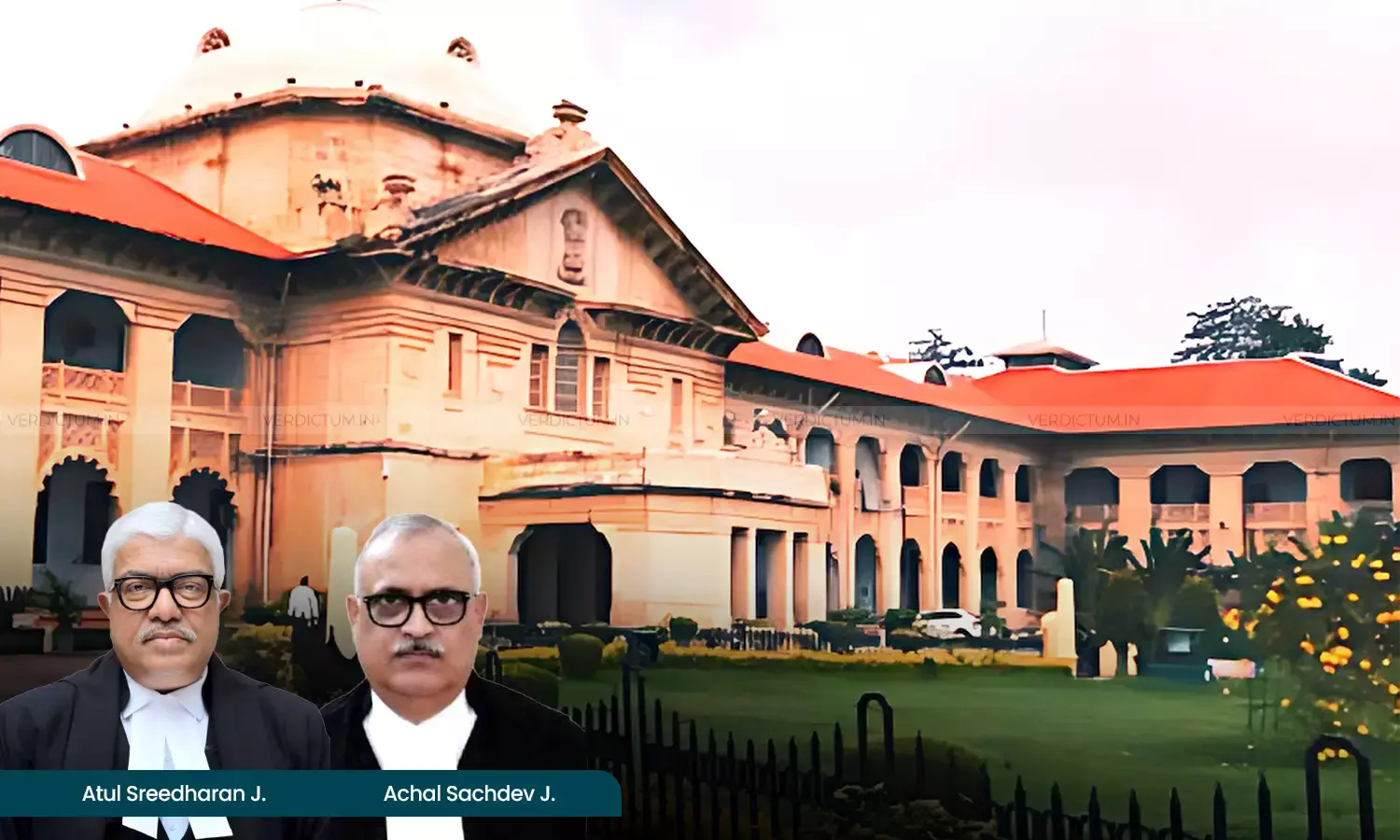
Justice Atul Sreedharan, Justice Achal Sachdev, Allahabad High Court
The Allahabad High Court has held that the preventive power under Section 170 of the BNSS cannot be invoked retrospectively once a cognizable offence has already been committed, since the purpose of preventing its commission no longer survives. The Court observed that where the offence has been committed, the police must proceed under Section 35(1)(c) of the BNSS, followed by an FIR and production before a Magistrate within twenty-four hours.
The Court held that detention under Sections 126 and 130 of the BNSS without first issuing the mandatory show-cause notice is unlawful. It directed the release of the petitioner and recorded its displeasure against the police officers concerned, observing that the police appear to be a law unto themselves.
A Division Bench of Justice Atul Sreedharan and Justice Achal Sachdev observed, “…The powers conferred under Section 170 of the BNSS are preventive in nature and may be exercised only where the police has knowledge of a design to commit a cognizable offence and considers such action necessary to prevent its commission. Once the offence has been committed, the preventive power under Section 170 of the BNSS cannot be invoked retrospectively, as the apprehended offence has been committed, and the purpose of preventing its commission no longer survives”.
“The police, however, are not helpless in cases where a cognizable offence has already been committed, as they are empowered to arrest a person without a warrant under Section 35(1)(c) of the BNSS…”, the Bench further noted.
The petitioner, Deepak, challenged his arrest in a case, registered on August 23, 2026 under Sections 109(1), 190, 191(2), 191(3), 115(2), 352 and 351(3) of the BNS. The State’s case was that he was first taken into preventive custody on August 23, 2026 at around 4:00 p.m. under Sections 126, 130 and 170 BNSS, and formally arrested on August 24, 2026 at 2:57 p.m.
The Court called for the original records and questioned the Investigating Officer and the ACP in person. The grounds of arrest, the arrest memo and the search and seizure document bore the Investigating Officer’s signature dated August 23, 2026, while stating that the arrest took place on August 24, 2026. The Section 130 notice was issued in the name of ACP-I but signed by ACP-II, and was served after the petitioner had already been taken into custody. The bail bonds left the bond amount blank and carried no order of acceptance or rejection.
The Court held that the discrepancies, repeated at five places and left uncorrected, raised a strong prima facie case that the documents were filled in later on a signed blank paper. It held that Section 130 requires a written order and prior notice, and that Section 170 was inapplicable as the offence had already occurred.
It noted that the GD entry did not record that the petitioner was told of his right to counsel under Section 38 BNSS and Article 22(1) of the Constitution of India, and held that the Magistrate erred in failing to scrutinise the papers. The Court said that the situation on the ground does not absolve the police of failing to follow the law.
The Court held the detention from 4:00 p.m. on August 23, 2026 unlawful and the arrest of August 24, 2026 unsustainable, as the grounds were inadequate and the documents appeared fabricated as to date. It directed that the petitioner be set at liberty forthwith if not wanted in any other case, and that its observations be recorded in the service books of ACP Kamlesh Kant and Investigating Officer Anuj Kumar. It requested the Director General of Police, U.P. to prepare better training modules, and directed that copies be sent to the DGP and to the Judicial Magistrate through the District Judge, Gautam Buddha Nagar.
Cause Title: Deepak v. State of U.P. & 3 Others (Neutral Citation: 2026:AHC:209894-DB)
Appearances:
Petitioner: Arpit Malviya and Awadhesh Kumar Malviya, Advocates.
Respondents: Kapil Kumar and Sandhya Singh, Advocates.