

Allahabad High Court Clarifies Powers Of Elders Committees In Bar Associations; Restrains Registrar, UP Bar Council From Interfering In Elections
The Court held seniority disputes must be decided under Advocates Act; warned Bar Associations against deviating from model bye-laws.

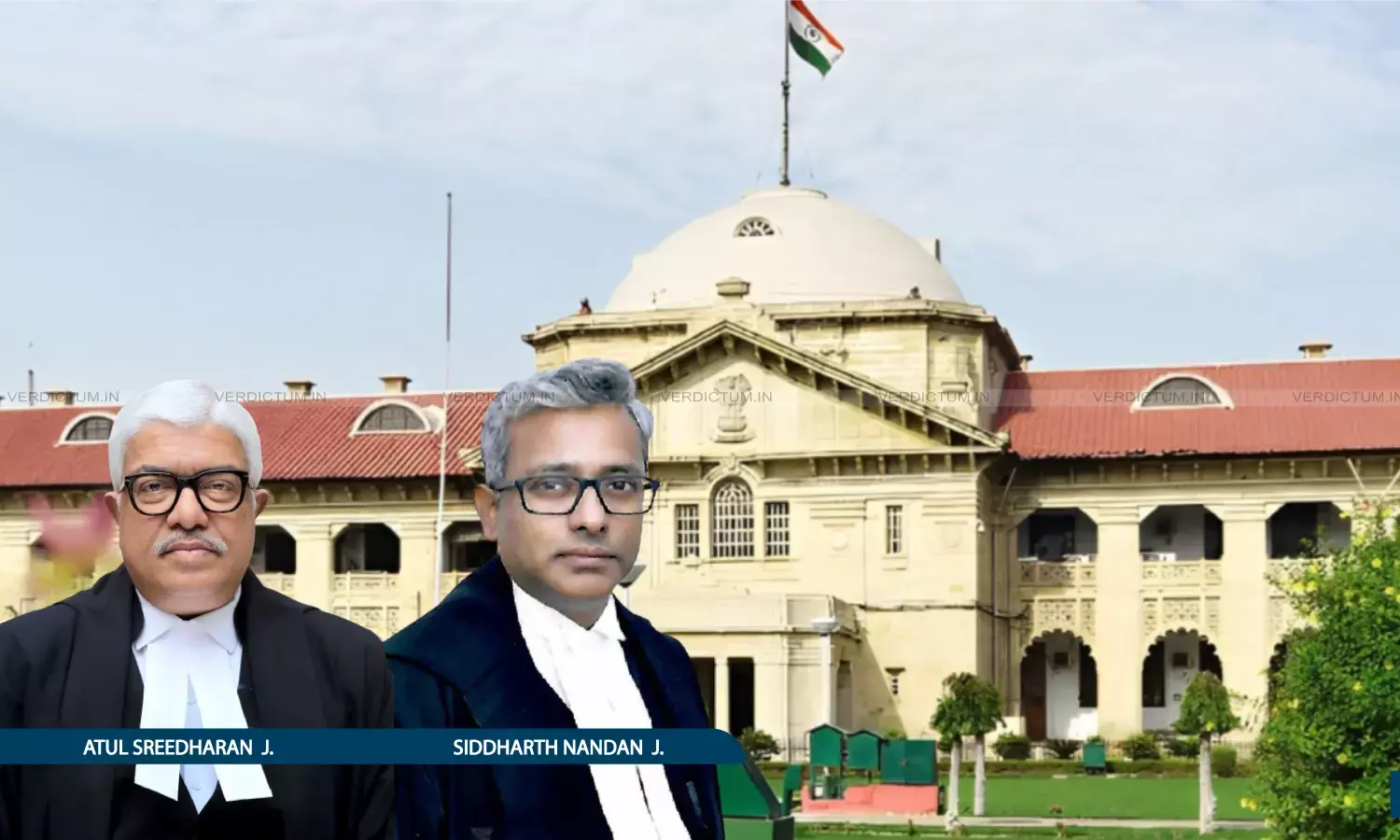
The Allahabad High Court has delivered a significant judgment governing the functioning, composition, and powers of Elders Committees in Bar Associations across Uttar Pradesh, holding that disputes relating to seniority among members of Bar Associations must be resolved exclusively under Section 21 of the Advocates Act, 1961 by the Bar Council of Uttar Pradesh, while simultaneously restraining the Bar Council from interfering with the electoral process of Bar Associations.
The Division Bench clarified that although the Bar Council of Uttar Pradesh is empowered to determine disputes regarding seniority among advocates, it cannot issue directions postponing Bar Association elections or otherwise interfere with the electoral process. The Court observed that elections to Bar Associations are to remain under the control of the Elders Committee constituted under the applicable bye-laws and model bye-laws.
Justice Atul Sreedharan and Justice Siddharth Nandan was dealing with two connected writ petitions, including one filed by Advocate Chandrashekhar Upadhyay challenging the constitution of the Elders Committee of the District Bar Association, Mau, and another petition questioning the legality of a 20-member election committee constituted for conducting Bar Association elections. It observed, “The concept of the constitution of Elders Committee, as it goes by its name "Elder", is correlated to his experience, connected with his age and that is why the Bar Council while adopting the Model Bye Laws has used the word ‘seniority’ and ‘Senior most’; if it is universally adopted all over the State or even in the country, such cases, which keep arising again and again disputing the constitution of the Elders Committee will come to an end”.
“…this court finds that such deviations, as detailed, herein above; and which are not in consonance with the Model By-Laws, cannot be permitted. Such non-conformity with the Model Bye-Laws and it's approval, by the Bar Council, cannot be permitted, for one Association and not for another. The only way to permit any deviation proposed by any Bar Association, is to consider the same by a democratic process and then pass a commensurate amendment in the Model Bye-Law; and also send the same for approval to the BCI; and once BCI approves, the amended Model Bye-Laws is to be implemented across the Bar Associations in State of UP. Any deviation prior to this, can only be construed as violation of Model Bye-Laws and can attract disaffiliation”, the Bench observed.
Advocates Manoj Kumar Dubey and Devendra Kumar Shukla appeared for the petitioner and Senior Advocate Rakesh Pande appeared for the respondent while Advocate Achintya Rai Sharma appeared as amicus curiae.
“In case of a breach of a bye-law of an Advocates Association, which has to be in conformity with the Model By-Laws, as propounded by the Bar Council of U.P., with respect to dispute of the seniority of a Member; and the bye-laws of the Association, makes provision to determine the seniority, taking into account the date of enrollment as an Advocate by the Bar Council (In case of an affiliated Bar Association of a District in State of U.P.); the only recourse available for the redressal of the said grievance is to approach the Bar Council of U.P. under Section 21 of the Act, 1961”, the Bench observed.
The Bench opened the judgment by invoking the celebrated words of Lord Denning, emphasising the foundational role of the Bar in the administration of justice and the need to preserve the dignity, discipline, and democratic functioning of Advocates Associations.
Addressing disputes concerning the constitution and functioning of Elders Committees, the Court ruled that in High Court Bar Associations, the committee must consist of the five senior-most designated advocates actively practicing before the High Court strictly in accordance with the seniority list maintained by the High Court itself. If any designated senior declines to serve, the next senior-most advocate in the list must be considered.
The Bench further clarified that if a dispute regarding the seniority of the Chairman of the Elders Committee arises, the remaining senior-most members of the committee may decide issues relating to deferment of elections by majority. Where elections are deferred beyond one month, the Elders Committee must convene an Extraordinary General Body Meeting to fix the election schedule.
The Court also laid down an extensive framework governing the powers and limitations of Elders Committees. It held that once an elected governing body fails to conduct elections within the prescribed period, the Elders Committee may assume administrative control of the Association, but only for limited purposes. The committee cannot take policy decisions or exercise unrestricted financial powers except for day-to-day administration and conduct of elections.
Observing that the Model Bye-Laws did not adequately address situations where the Elders Committee itself fails to conduct elections within one month, the Court issued interim directions to fill the legislative vacuum. It held that in such circumstances, the continuation of the Elders Committee must be subject to approval by the General Body of the Association, and election dates must ultimately be fixed through an Extraordinary General Meeting.
The Bench emphasized that Bar Associations occupy a distinct position and cannot be equated with ordinary societies or clubs.
“The question whether in case of a dispute with respect to the continuation of a Member of the Committee or a dispute regarding the elections, it is no longer res integra that Section 25(2) of the Act, 1860, which gives power to the Registrar to hold the elections of the Society of the Committee of Management, after the expiry of its term, shall have no applicability in the case of Bar Associations; since the same are conducted in accordance with the Model Bye-Laws or under the Rules of the ‘Advocates Associations’, which are duly approved by the Bar Council of the State and Bar Council of India, which are the statutory bodies under the Advocates Act, 1961. [Also Ref. To Bar Association & Anr. v. State of U.P. and 4 others C.M.W.P. No. 34436 of 2013]”, it said.
The Court observed that Advocates Associations perform functions intrinsically connected with the administration of justice and therefore discharge significant public duties. Stressing the importance of maintaining institutional discipline within the legal profession, the Bench remarked that the proper functioning of Bar Associations directly impacts the justice delivery system.
In a significant direction applicable across the State, the Court ordered the Bar Council of Uttar Pradesh to circulate the judgment to all affiliated Bar Associations and ensure strict compliance with the Model Bye-Laws. It further directed that any Bar Association whose bye-laws are inconsistent with the approved Model Bye-Laws must amend them within a reasonable period, failing which disaffiliation proceedings may be initiated.
The Court also recommended that the State Bar Council constitute a permanent committee to democratically examine proposed amendments and suggestions relating to Model Bye-Laws before forwarding them to the Bar Council of India for approval.
Applying the principles laid down in the judgment, the Court set aside the nomination of members to the Elders Committee of the District Bar Association, Mau, holding that the appointments were contrary to the Model Bye-Laws. It also quashed the constitution of a 20-member committee formed for conducting elections in another Bar Association, observing that such a body had no sanction under the governing bye-laws.
The Bench concluded by observing that disputes within Bar Associations should, as far as possible, be resolved amicably and through in-house mechanisms in order to preserve institutional harmony and ensure the smooth administration of justice.
Cause Title: Chandrashekhar Upadhyay, Advocate v. State of UP and 8 others (Neutral Citation: 2026:AHC:116231-DB)
Appearances:
Petitioner: Manoj Kumar Dubey and Devendra Kumar Shukla, Ashok Kumar Upadhyay, Advocates.
Respondents: Ashok Kumar Tiwari, Rakesh Pande, Senior Advocate, Vishakha Pande, Advocate Manoj Kumar Mishra, Standing Counsel, Naina Sharma, Advocate and Achintya Rai Sharma, Advocate, as Amicus Curiae.