

Persistent Humiliation Touching Upon Domestic Life & Dignity Can Amount To Instigation For Suicide: Allahabad High Court
The Allahabad High Court was considering a criminal appeal filed against the orders rejecting the discharge application of the accused.

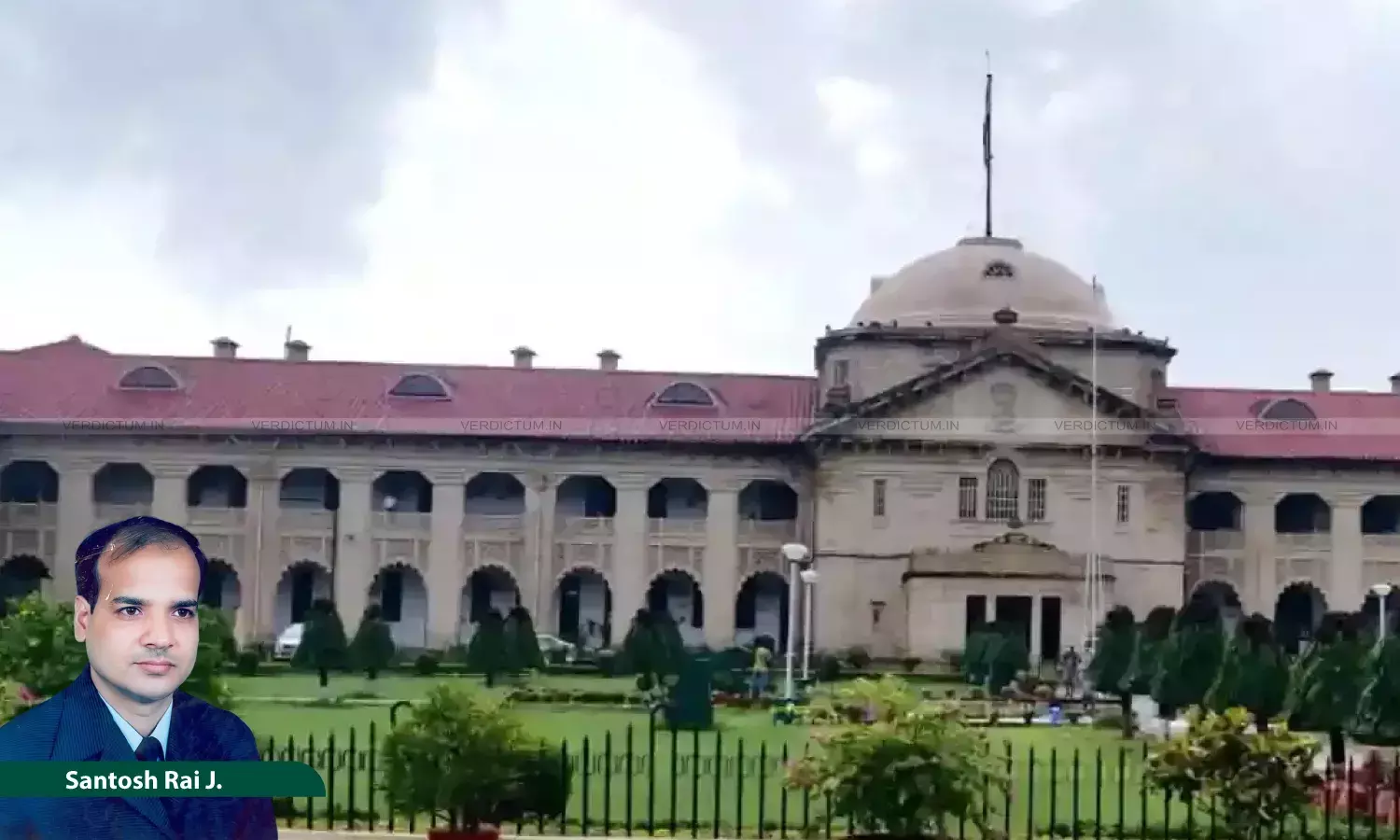
While upholding an order of the Trial Court rejecting a discharge application of an accused booked in an abetment to suicide case registered under Section 306 of the Indian Penal Code, the Allahabad High Court has held that the persistent humiliation of a person, particularly when it touches upon their domestic life and dignity, can amount to instigation.
The High Court was considering a crimial appeal filed under Section 14 A (1) of S.C.& S.T. Act against the orders whereby the discharge application of the appellant filed under Section 227 Cr.P.C. was rejected and charges were framed against him and the deceased’s wife (co-accused) under Section 306 of the IPC while the co-accused Gulshan was charged under Sections 306 and Section 3(2)5 S.C. & S.T. Act.
The Single Bench of Justice Santosh Rai explained, “The scope of interference in an appeal against the rejection of a discharge application is extremely limited. The Court is only required to determine whether there is a prima facie case to frame charges. The court should not act as a mere post office but must see if the facts, even if taken at face value, disclose an offence. Here, the suicide note is a critical piece of evidence that narrates a systematic pattern of humiliation. While "abetment" under Section 108 BNS requires mens rea and an active act of instigation, the persistent humiliation of a person, particularly when it touches upon their domestic life and dignity, can indeed amount to instigation.”
Senior Advocate Sadrul Islam Jafri represented the Appellant while Governement Advocate Anup Kumar Pandey represented the Respondent.
Factual Background
The First Information Report was lodged by the mother of the deceased, stating that the deceased Somraj was married to the co-accused. After the marriage, his wife allegedly maintained an illicit relationship with the appellant and co-accused, due to which the matrimonial disputes frequently arose. It was alleged that despite repeated efforts by the deceased and his family members to persuade the accused persons, they continued to remain in contact with each other. The informant further alleged that the accused persons used to threaten, harass and mentally torture the deceased, causing him severe mental distress. As per the mother, the deceased had also informed his family members that the accused persons were responsible for his harassment and apprehended danger to his life.
According to the prosecution, the deceased was found hanging inside his room. The family members broke open the door and found him dead. It was further alleged that before his death, the deceased left handwritten suicide notes, wherein he specifically held the accused's wife, Chandrajeet and Gulshan responsible for his death. The appeal was filed on the ground that the impugned order was wholly arbitrary, unjust, unreasonable and illegal.
Reasoning
The Bench found that the ‘suicide note’ collected by the IO was proved by the FSL report and the same was written in the handwriting of the deceased. In the suicide note, an allegation was made against the appellant and others regarding continuous humiliation on the ground that his wife had an illicit relationship with the accused appellant. As per the medical evidence in the postmortem report, the cause of death was hanging.
The Bench found that the allegations in the suicide note suggested that the accused exploited the vulnerability of the deceased to commit the acts of humiliation. As per the Bench, the same warranted a full trial to ascertain the intent and the social context of the harassment.
“There is sufficient material to frame charges and proceed. The learned Trial Court has exercised its jurisdiction in accordance with the law. No jurisdictional error or perversity is found in the impugned order. The contention of the appellant that he is entitled to discharge is devoid of merit, as the veracity of the suicide note and the "causal link" between the accused's conduct and the suicide are matters to be tested during the trial”, it held.
Thus, in light of such aspects and considering the first information report, suicide note and material evidence available in the case diary, the Bench upheld the order of the Trial Court and rejected the appeal.
Cause Title: Chandrajeet Singh v. State of U.P. and Another (Neutral Citation: 2026:AHC:137745)
Appearance
Appellant: Senior Advocate Sadrul Islam Jafri, Advocate Meraj Ahmad Khan
Respondent: Government Advocate Anup Kumar Pandey