

Protest Petition Not Automatically A Complaint: Allahabad High Court Quashes Proceedings Against 13 Police Personnel, Issues Guidelines For Deciding Closure Reports
The Court held that a Special Court under the SC/ST Act must follow the procedure prescribed for a Court of Session and cannot adopt the procedure for a Magistrate’s warrant case merely because the proceedings originated from a protest petition.
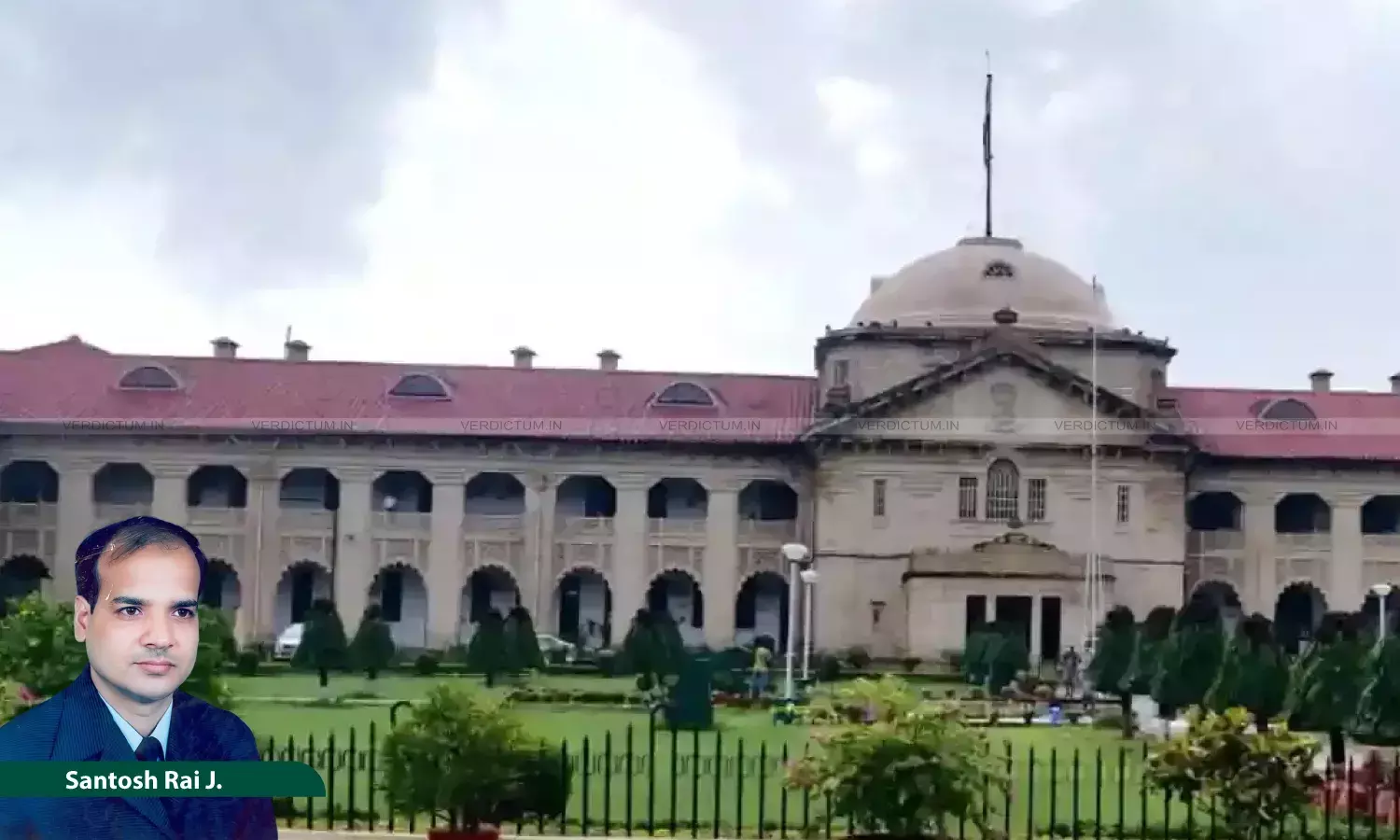
The Allahabad High Court has held that filing a protest petition with affidavits does not automatically convert it into a complaint, and the Court must expressly determine the course to be adopted on the police final report.
Setting aside the cognizance order and consequential proceedings against 13 police personnel, the Court issued guidelines to criminal courts across Uttar Pradesh for deciding final reports and proceeding on protest petitions.
The Court was hearing a criminal appeal under Section 14-A of the Scheduled Castes and the Scheduled Tribes (Prevention of Atrocities) Act, 1989, challenging an order of the Special Judge, Meerut, which rejected a police final report, treated the complainant’s protest petition as a complaint and initiated proceedings against the appellants.
A Bench of Justice Santosh Rai observed: “Mere filing of a protest petition along with affidavits shall not, by itself, result in its automatic conversion into a complaint. The Court shall clearly determine whether it proposes to accept the Final Report or reject the Final Report and treat the protest petition as a complaint in accordance with law.”
Senior Advocate Saghir Ahmad appeared for the appellants. Advocate Sanjay Kumar Srivastava appeared for the complainant, while Additional Government Advocate Shyam Narayan Rai appeared for the State.
Background
The complainant alleged that, after she demanded repayment of a ₹20,000 loan, the debtor colluded with police personnel who subjected her to caste-based abuse, assault and custodial ill-treatment. She also alleged that cash and valuables went missing. A separate criminal case arising from the same incident had been registered against her for allegedly assaulting and obstructing police personnel, following which she was arrested and sent to jail. The Investigating Officer subsequently submitted a final report in her complaint, stating that supporting evidence was absent and describing the allegations as a counterblast to the earlier prosecution.
The complainant filed a protest petition supported by witness affidavits, photographs and newspaper cuttings. The Special Court rejected the final report, registered the protest petition as a complaint and subsequently summoned the appellants. It later recorded evidence under Section 244 of the Code of Criminal Procedure, 1973, and rejected their discharge application under Section 245.
The appellants contended that the foundational order lacked reasons, relied mechanically on material accompanying the protest petition, disclosed no individual allegations satisfying the SC/ST Act and ignored the question of prosecution sanction. The complainant maintained that the Special Court could disagree with the investigation and proceed on her complaint, that sanction could be considered during trial, and that the appeal was barred because the challenged order was interlocutory.
Court’s Observations
Applying Amar Nath v. State of Haryana (1977), Madhu Limaye v. State of Maharashtra (1977), K.K. Patel v. State of Gujarat (2000) and Girish Kumar Suneja v. Central Bureau of Investigation (2017), the Court held that the order was intermediate rather than purely interlocutory.
The Court explained: “It has the substantive effect of rejecting the conclusion reached by the Investigating Officer in the final report, setting the criminal law in motion on the basis of the protest petition and initiating a complaint proceeding against the appellants. If the impugned order is set aside, the proceedings initiated pursuant thereto would come to an end; conversely, if it is sustained, the criminal proceedings would continue. It, therefore, squarely falls within the category of an intermediate order and not a purely interlocutory order.”
The Court also relied on the Full Bench decisions in Gulam Rasool Khan v. State of U.P. (2022) and In Re: Provision of Section 14-A of the SC/ST Act (2018). It noted their position concerning intermediate orders and the absence of a limitation period for appeals under the Act, and rejected the maintainability objection.
The Court found that the allegations did not individually attribute caste-motivated conduct to the appellants under the Scheduled Castes and the Scheduled Tribes (Prevention of Atrocities) Act, 1989. Referring to Hitesh Verma v. State of Uttarakhand (2020) and Shajan Skaria v. State of Kerala (2024), it held that the complainant’s caste status alone could not establish the alleged offences.
The Court observed: “There is no specific casteist utterance attributed to any particular appellant. There is also no specific allegation explaining as to which accused knew the caste identity of the informant, in what manner such knowledge was acquired, and how the alleged act was motivated by the caste identity of the informant. Mere reference to the fact that the informant belongs to a Scheduled Caste cannot substitute the statutory requirement that the alleged act must have been committed because of her caste status.”
The Court regarded the contemporaneous prosecution of the complainant, injuries allegedly suffered by police personnel and the approximately four-month interval before registration of her case as relevant circumstances. It clarified that delay alone was not necessarily fatal, but these circumstances required consideration when examining the subsequent prosecution. Applying State of Haryana v. Bhajan Lal (1992), it held that proceedings could not continue on omnibus allegations lacking the foundational ingredients of the offences.
The Court distinguished cognizance based on investigation material under Section 190(1)(b) of the Code of Criminal Procedure, 1973, from proceedings on an independent complaint under Section 190(1)(a). Referring to Rama Kant v. State of U.P. (2010), Dinesh Kumar Soni v. State of U.P. (2010), Mukhtar Zaidi v. State of U.P. (2024) and Vimlesh v. State of U.P. (2010), it emphasised the need to follow the applicable complaint procedure.
The Court held: “Thus, affidavits accompanying a protest petition do not automatically become substantive evidence; their nature and relevance must be examined, and if the Court proceeds on them by treating the protest petition as a complaint, it is also required to be verified whether the facts of the complaint constitute such offence in light of Section 190 Cr.P.C., thereafter, the statutory complaint procedure must be followed.”
The Court found inconsistencies concerning witness presence, the time of occurrence and whether particular witnesses had personally witnessed the incident or merely received information from others. It also held that photographs and newspaper reports could not, without examination of their relevance and evidentiary nature, displace the Investigating Officer’s conclusion.
Relying on Kranti Associates Private Limited v. Masood Ahmed Khan (2010) and Birla Corporation Limited v. Adventz Investments and Holdings Limited (2019), the Court held that the order had to demonstrate objective consideration of relevant material.
The Court remarked: “The order does not disclose what particular material in the case diary was found insufficient, what material was found reliable, or why the conclusion of the Investigating Officer was unacceptable. More importantly, the learned Special Court has relied upon ‘photographs and newspaper cuttings’ without recording their relevance or evidentiary value and has failed to notice the material contradictions regarding the presence of witnesses and the time and manner of the alleged occurrence.”
It held that merely stating that the case diary and accompanying documents had been perused did not constitute a reasoned judicial determination.
The Court held that the apparent connection between the alleged incident and the appellants’ official functions required examination of Section 197 of the Code of Criminal Procedure, 1973. It referred to Matajog Dobey v. H.C. Bhari (1955), Abdul Wahab Ansari v. State of Bihar (2000), State of Orissa v. Ganesh Chandra Jew (2004), D. Devaraja v. Owais Sabeer Hussain (2020) and Amod Kumar Kanth v. Association of Victim of Uphaar Tragedy (2023).
The Court underscored: “Where Section 197 Cr.P.C. applies, previous sanction is a condition precedent to the Court taking cognizance of the offence. Therefore, before converting the protest petition into a complaint and proceeding against the appellants, the learned Special Court was required to satisfy itself whether the statutory requirement of previous sanction had been complied with. The question could not have been completely ignored and left unexamined.”
The Court did not treat official status as an automatic answer to the allegations. It held that the Special Court first had to determine whether the alleged acts had a reasonable nexus with official duty and, if so, whether previous sanction existed.
Referring to Gangula Ashok v. State of Andhra Pradesh (2000), the Court held that designation as a Special Court under the SC/ST Act did not alter its character as a Court of Session. The applicable discharge and charge provisions were Sections 227 and 228 of the Code of Criminal Procedure, 1973, rather than the Magistrate’s warrant-case provisions in Sections 244 and 245.
The Court observed: “The learned Special Court, by proceeding under Sections 244 and 245 Cr.P.C., has consequently deprived the appellants of consideration of their case for discharge in the manner specifically prescribed for a Court of Session. Thus, the learned Special Court was required to proceed in accordance with Chapter XVIII Cr.P.C. and to consider the question of discharge, if raised, under Section 227 Cr.P.C.”
It held that this was not merely a reference to an incorrect provision while following the correct procedure; the proceedings had actually been conducted on an erroneous procedural basis.
Considering Pradeep S. Wodeyar v. State of Karnataka (2021), the Court held that the cumulative defects were not harmless irregularities curable under Section 465 of the Code of Criminal Procedure, 1973.
The Court held: “Such an omission, particularly when challenged at the threshold and when it affects the valuable statutory protection available to public servants, has occasioned failure of justice and cannot be saved by invoking Section 465 Cr.P.C. The impugned order, therefore, calls for interference in exercise of the appellate jurisdiction of this Court.”
The Court directed criminal courts in Uttar Pradesh, subject to the applicable statutory provisions, to independently examine final reports and investigation material, expressly identify the police-report or complaint course, and record specific, brief reasons. Where a protest petition is treated as a complaint, its allegations must disclose an offence under Section 190(1)(a) of the Code of Criminal Procedure, 1973, or Section 210(1)(a) of the Bharatiya Nagarik Suraksha Sanhita, 2023.
The guidelines also require lawful assessment of annexures, reasoned cognizance orders and consideration of the specific role attributed to each accused. Courts must follow the applicable complaint-examination provisions, preserve the distinction between preliminary inquiry and Sessions trial, consider prosecution sanction where applicable, and elicit necessary clarification during inquiry.
Addressing police supervision, the Court directed: “A Final Report shall, as required by Rule 122 of the U.P. Police Regulations, be submitted through the Superintendent of Police/Commissioner of Police (Head of Police Administration of district), who is required to exercise appropriate supervisory scrutiny before its submission to the court. Further, the complainant/informant shall be duly informed of the submission of the Final Report by Investigating Officer, in accordance with law.”
The Court further directed expeditious disposal of final reports, ordinarily within one month of submission. District and Sessions Judges must monitor compliance through monthly judicial-officer and monitoring-cell meetings and issue administrative guidance where recurring departures are noticed.
Conclusion
The Court allowed the appeal, set aside the order rejecting the final report and initiating complaint proceedings, and quashed all consequential proceedings against the appellants. They were discharged from proceedings arising from the impugned order.
The judgment was directed to be transmitted to the concerned Court within 48 hours. The Registrar General was directed to circulate it to all judicial officers in Uttar Pradesh and forward it to the Director of the Judicial Training and Research Institute, Lucknow, for appropriate guidance.
Cause Title: Bhuvnesh Kumari and 12 Others v. State of U.P. and Another (Neutral Citation: 2026:AHC:192431)
Appearances
Appellants: Senior Advocate Saghir Ahmad, assisted by Advocate Mohd. Raghib Ali
Respondents: Additional Government Advocate Shyam Narayan Rai, Advocate Sanjay Kumar Srivastava
