Police Need Not Decide Truth Of Allegations At FIR Stage: Allahabad High Court Directs UP DGP To Examine Non-Registration Of Sexual Assault Complaint
The High Court said a pre-FIR police report could not be treated as a final adjudication of allegations or as a reason to shift the burden of investigation onto the complainant.
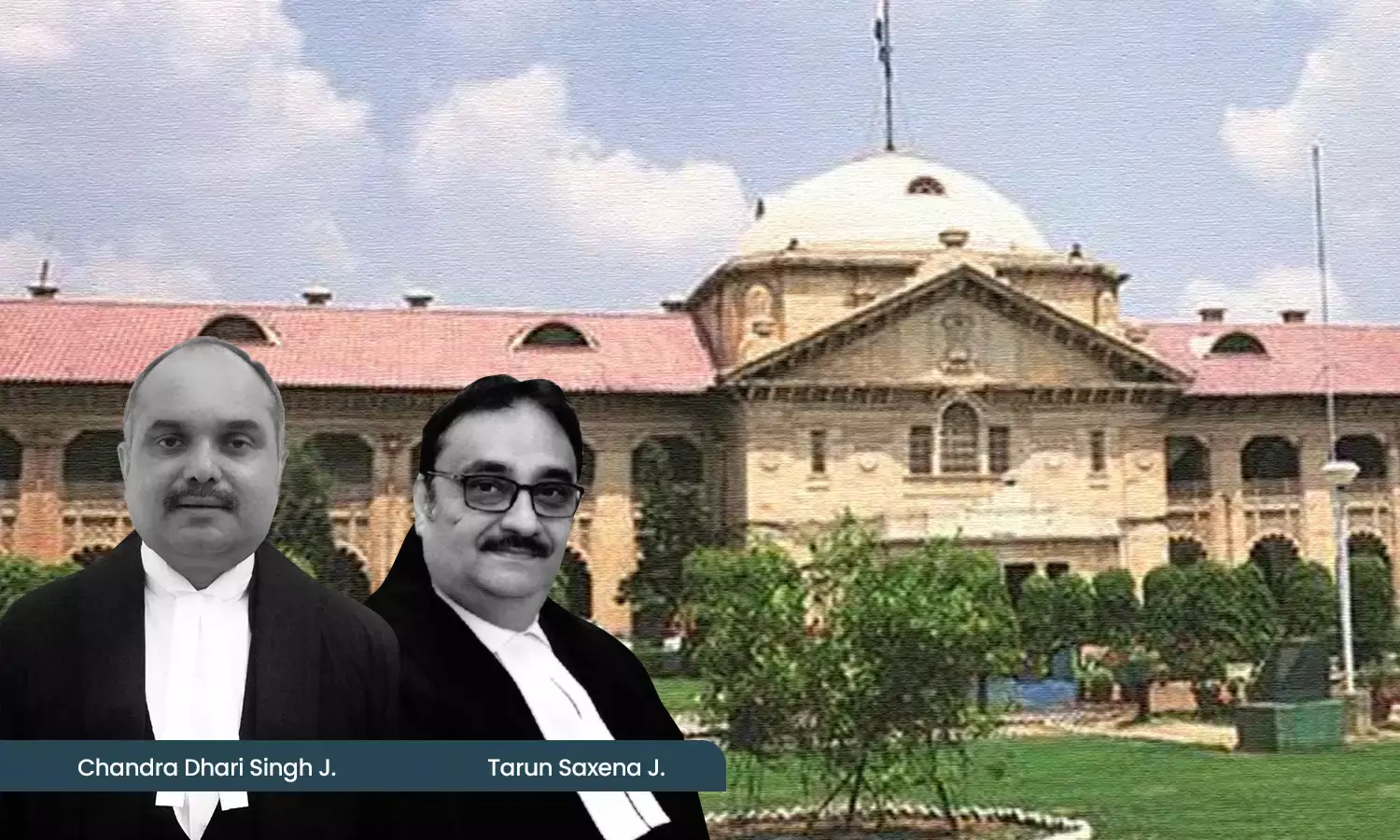
The Allahabad High Court has held that where a complaint discloses cognizable offences, the police must receive the complaint, register an FIR, conduct a fair investigation and place the result before the competent court, instead of deciding the truth or falsity of the allegations at the stage of registration.
The Court, while making these observations, directed the Director General of Police, Uttar Pradesh, to examine why the complaint made by the prosecutrix was not registered by the concerned police station and why no FIR was registered even after she complained to the Commissioner of Police, Ghaziabad.
The Court was hearing a writ petition under Article 226 of the Constitution seeking quashing of an FIR registered at Police Station Wave City, Ghaziabad, under Sections 64, 74, 75(2), 76 and 351(3) of the Bharatiya Nyaya Sanhita, 2023, and a direction restraining the petitioner’s arrest.
A Bench of Justice Chandra Dhari Singh and Justice Tarun Saxena observed: “The duty of the police is to receive the complaint, register an FIR where cognizable offences are disclosed, conduct a fair investigation and place the result of the investigation before the competent court. The ultimate determination regarding the truth of the allegations, the credibility of witnesses, the admissibility and sufficiency of evidence and the guilt or innocence of the accused is for the criminal court to decide in accordance with law.”
The Bench also remarked: “The police are required to register the information, investigate the allegations and collect evidence. They are not required to decide the ultimate truth or falsity of the allegations at the stage of registration.
Advocates Anuj Bajpai and Sanjay Kumar Mishra appeared for the petitioner, while G.A. appeared for the respondents.
Background
The FIR arose from allegations made by the prosecutrix, who stated that she was employed as an Admin in the petitioner’s company and alleged sexual misconduct, threats and criminal intimidation by him during the course of employment. She stated that she resigned because of the alleged misconduct and later approached Police Station Wave City to lodge a report, but no action was taken.
The prosecutrix thereafter stated that she submitted a complaint to the Commissioner of Police, Ghaziabad, but no FIR was registered even then. She then approached the Additional Chief Judicial Magistrate under Section 173(4) BNSS, following which a police report was called for. The report stated that she had not produced WhatsApp chats, call recordings or social media conversations and described the allegations as false and baseless.
The Magistrate accepted the application and directed registration of an FIR. Before the High Court, the petitioner contended that the FIR was a counter-blast to an earlier extortion case lodged by him and that the Magistrate had mechanically directed registration despite the police report. The State opposed the plea, arguing that the allegations disclosed cognizable offences and required investigation.
Court’s Observations
The Court held that the petitioner’s defence raised disputed questions of fact which could not be conclusively determined in proceedings seeking quashing of the FIR.
The Court observed: “The Court cannot, in the present proceedings, conclusively determine whether Case Crime No. 294/2026 was genuine or falsely engineered, whether the prosecutrix was involved in the extortion demand, whether the allegations of sexual misconduct are true, or whether the present FIR was filed as a counter-blast. These questions require investigation, collection of evidence, examination of witnesses and appreciation of the material in accordance with law.”
The Court rejected the contention that the Magistrate had ignored the police report. It noted that the Magistrate had called for the report, considered it, examined the seriousness of the allegations and then directed registration of the FIR.
The Court held: “A police report submitted at the pre-FIR stage is not binding upon the Magistrate where the complaint, taken at its face value, discloses cognizable offences requiring investigation.”
The Court said the police report had proceeded mainly on the ground that the prosecutrix had not produced WhatsApp chats, call recordings or social media conversations. It held that the allegations were not confined to electronic communication and included physical acts, threats and alleged misuse of an employment relationship.
The Court observed: “The Call Detail Records, location records, subscriber details and other electronic evidence, if legally obtainable and available, can be collected by the investigating agency after registration of the FIR. It was not proper for the police to treat the non-production of such material by the prosecutrix as a reason to refuse registration of the FIR. The burden of conducting a lawful investigation cannot be shifted upon the prosecutrix at the stage when she approaches the police with information disclosing cognizable offences.”
Relying on Lalita Kumari v. Govt. of UP and Neeharika Infrastructure Pvt. Ltd. v. State of Maharashtra, the Court held that where information discloses a cognizable offence, registration of an FIR is mandatory and the police have a statutory duty to investigate.
The Court stated: “The present case does not fall within the narrow category in which the allegations, even if accepted in their entirety, disclose no offence. Nor is this a case where the allegations are so absurd, inherently impossible or legally barred that no investigation can be permitted. On the contrary, the factual allegations, taken at face value, disclose offences which require investigation.”
The Court declined to accept the petitioner’s argument that the FIR should be quashed because it was allegedly lodged as a counter-blast to the earlier extortion case. It found that both versions required proof and could not be adjudicated on affidavits.
The Court held: “The two FIRs therefore disclose different alleged occurrences and different causes of action. The existence of Case Crime No. 294/2026 does not bar investigation into Case Crime No. 0194/2026. The two cases may be investigated and dealt with independently in accordance with law.”
The Court noted that allegations of sexual harassment and sexual assault in the workplace required a sensitive, fair and legally compliant investigation, while also safeguarding the rights of the accused.
The Court observed: “Both requirements are fulfilled by permitting the investigation to proceed rather than terminating it at the threshold.”
It further said that quashing the FIR before evidence was collected may convey that workplace sexual misconduct allegations are to be disbelieved at the threshold whenever an employer relies on a previous criminal case or absence of contemporaneous electronic evidence.
Before parting, the Court noted that the prosecutrix had stated that she first approached Police Station Wave City and later the Commissioner of Police, Ghaziabad, but no FIR was registered.
The Court observed: “It is difficult to understand why the concerned police station did not register an FIR when the prosecutrix approached it with allegations which, on their face, disclosed cognizable offences. It is equally difficult to understand why the complaint dated 07.07.2026 addressed to the Commissioner of Police, Ghaziabad, did not result in registration of an FIR or in an effective investigation.”
The Court said the police were required to register the information, investigate the allegations and collect evidence, and were not required to decide the ultimate truth or falsity of allegations at the registration stage.
Conclusion
The High Court dismissed the writ petition and rejected the prayer to quash the FIR. It clarified that it had not expressed any final opinion on the merits of the criminal case and that its observations were confined to the writ petition.
The Court directed the DGP, Uttar Pradesh, to examine why the prosecutrix’s complaint was not registered by the concerned police station and why no FIR was registered on her complaint to the Commissioner of Police, Ghaziabad. The inquiry was directed to examine the conduct of personnel posted at Police Station Wave City and the role of the concerned officers, including the Commissioner of Police, Ghaziabad.
The DGP was directed to issue show-cause notices to the concerned police personnel, including the SHO of Police Station Wave City, officers responsible for dealing with the complaint before the Commissioner of Police, Ghaziabad, and the Commissioner himself. The DGP was also directed to examine whether the police report was prepared after a lawful and fair preliminary assessment and whether failure to produce electronic material could lawfully be treated as a ground to refuse FIR registration.
The DGP was directed to personally supervise the inquiry and submit a report by personal affidavit within four weeks. The Commissioner of Police, Ghaziabad, was directed to ensure that the investigation is conducted fairly, impartially and in accordance with law. The matter was directed to be listed in chambers after four weeks for consideration of the affidavit and compliance report.
Cause Title: Arpit Gupta v. State of U.P. and 2 others (Neutral Citation: 2026:AHC:168404-DB)