

Successive Execution Applications Not Required For Receiving Monthly Maintenance: Allahabad High Court
The Court ruled that maintenance under Section 125 CrPC is a continuous liability, directing trial judges to enforce direct bank deposits or salary deductions for swift execution.

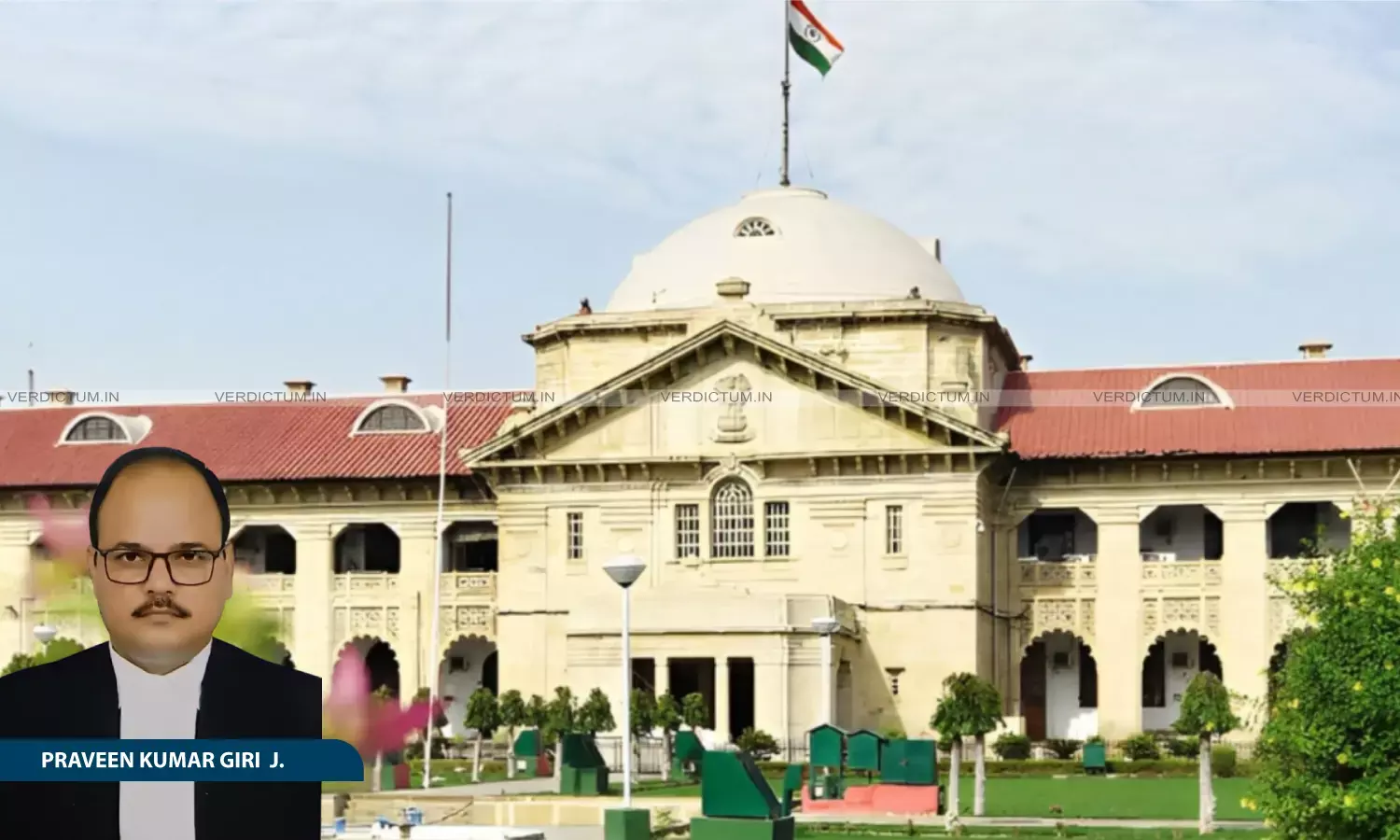
Justice Praveen Kumar Giri, Allahabad High Court
The Allahabad High Court set aside an order of the Family Court that had closed execution proceedings merely upon the husband's depositing a single month's arrears.
Emphasizing that a maintenance decree under Section 125 Cr.P.C. creates a continuing legal obligation, the Bench held that wives are not required to repeatedly approach the court by filing successive execution applications for every recurring default.
To ensure prompt enforcement and prevent statutory relief from becoming illusory, the High Court issued binding directions to all Presiding Officers of Family Courts and Gram Nyayalayas across Uttar Pradesh, mandating that maintenance be transferred directly into the claimant’s verified bank account, instructing employers to deduct arrears directly from salaried spouses, and warning that default would invite property attachment, simple imprisonment, as well as disciplinary or contempt action against non-compliant officers.
The Bench of Justice Praveen Kumar Giri directed, "All the Presiding Officers of the Family Courts and Gram Nyayalayas of the State of U.P. are directed to ensure strict compliance with the following directions: (i) The trial court shall follow the law laid down by the Hon'ble Supreme Court in Shanta Alias Ushadevi (supra) to the effect that successive execution applications are not required to be filed for receiving monthly maintenance...(ii) The trial court shall also follow the law laid down by the Hon'ble Supreme Court in Poongodi (supra) to the effect, that the first proviso to Section 125(3) Cr.P.C./Section 144(3) B.N.S.S. does not create any bar or affect upon the entitlement of a claimants to recover arrears of maintenance beyond a period of one year."
Advocate Kalpna Upadhyay appeared for the Petitioner, while Advocate Mayank Awasthi appeared for the State.
Brief Facts
The revisionist-wife filed an application under Section 125 of the Code of Criminal Procedure seeking maintenance from her husband, the opposite party. The Family Court allowed the application and directed the husband to pay a monthly maintenance allowance to the wife. Subsequently, the wife instituted execution proceedings under Section 128 Cr.P.C., which were disposed of upon the husband clearing the accumulated arrears up to that period.
Thereafter, the wife filed a second execution application seeking future monthly maintenance and arrears for the unpaid intervening month. The Family Court initially issued a recovery warrant but subsequently recalled it after the husband deposited the single month's arrears.
Ultimately, the Family Court rejected the wife's execution application under the proviso to Section 125(3) Cr.P.C. and consigned the case to the record room, holding that no further recovery could be made and observing that recovery warrants could not be issued for future monthly payments not yet due. Aggrieved by this order, the wife preferred the present criminal revision.
Contentions of the Parties
The Revisionist/Wife submitted that the original maintenance order remained valid, operative, and had never been recalled or set aside by any competent court. It was contended that the Family Court erred in rejecting the execution application merely because the husband deposited arrears for one month, thereby practically nullifying the continuous effect of the maintenance order.
It was urged that the proviso to Section 125(3) Cr.P.C. merely restricts the procedure for issuing recovery warrants beyond the limitation period, but does not extinguish the wife's underlying entitlement to maintenance or bar enforcement remedies.
It was submitted that requiring the wife to file successive execution applications for every default was unreasonable and contrary to established legal principles.
The State supported the stand that a maintenance order creates a continuous legal obligation on the husband so long as it remains in force.
Observations and Directives of the Court
The Court observed that an order passed under Section 125 Cr.P.C. creates a continuing liability. The Family Court acted erroneously in terminating execution proceedings upon a partial deposit, as the husband remained under a persistent legal obligation to pay monthly maintenance.
Relying on Supreme Court precedents, the Court held that wives are not required to file fresh, successive execution applications for each monthly default.
The Court clarified that the one-year limitation under the proviso to Section 125(3) Cr.P.C. limits only the specific procedure of issuing recovery warrants or ordering detention, but does not extinguish the wife's right to claim outstanding maintenance arrears.
To prevent repeated litigation, the Court directed that maintenance amounts be directly deposited into the verified bank account of the claimant. Where the husband is in salaried employment, trial courts were instructed to order the employer to deduct maintenance directly from his remuneration.
The Court directed, "In the event of refusal of payment of maintenance or non-payment of maintenance due to insufficiency of funds, the trial court shall recover the amount by attaching the property of the opposite party/person, liable to pay maintenance, in accordance with law and if the attached property is insufficient to clear the unpaid arrears of maintenance, an order of simple imprisonment may be directed to be executed for a term which may extend to one month for each month's default or until payment, if sooner made, as per Section 125(3) Cr.P.C./Section 144(3) B.N.S.S.; and the law laid down by the Hon’ble Supreme Court in Rajnesh vs. Neha; (2021) 2 SCC 324."
The Court directed all Family Courts and Gram Nyayalayas in the State to ensure strict compliance with these enforcement mechanisms, warning that failure to execute maintenance orders in letter and spirit would attract disciplinary and contempt proceedings.
Cause Title: Mala Kumari v. State of U.P. and Anr. [Neutral Citation: 2026:AHC:152860]
Appearances:
Petitioner: Advocate Kalpna Upadhyay
Respondents: Advocate Mayank Awasthi